
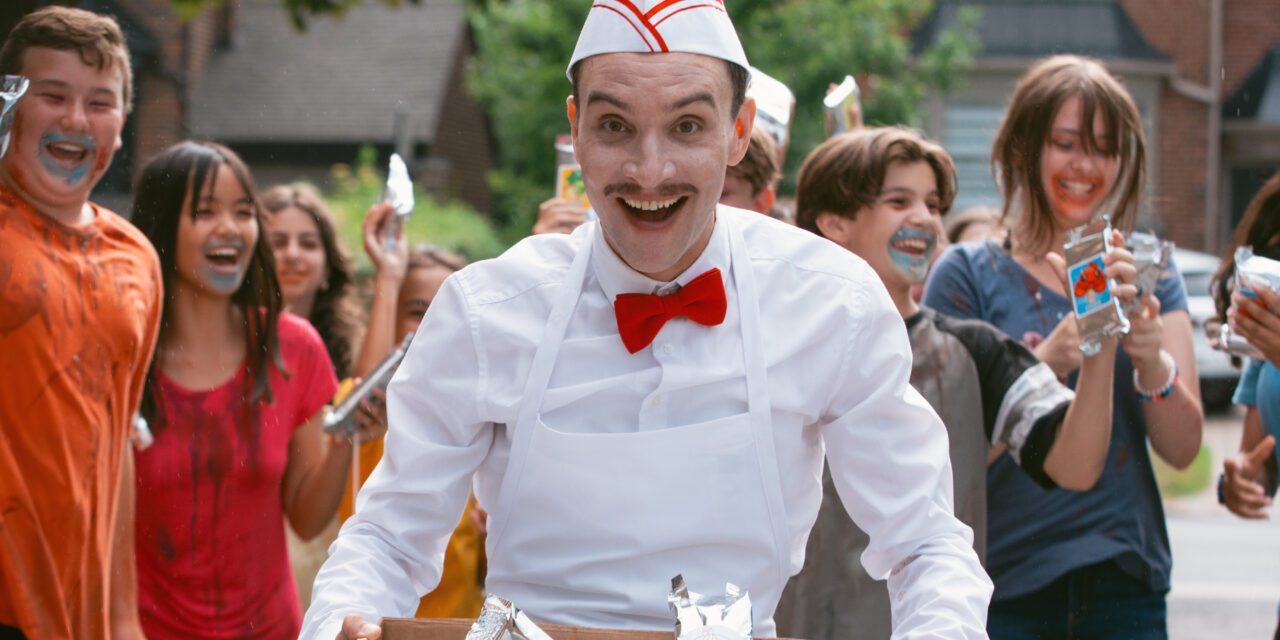
Ice Cream Man, directed by Eli Roth, begins with one of childhood’s most familiar symbols of happiness: the sound of an ice cream truck arriving on a warm afternoon. The sound that once meant excitement, summer afternoons, and a sweet treat waiting around the corner suddenly becomes something to fear. When the mysterious ice cream man, Jonathan Smiley (played by Ari Millen), arrives in the quiet neighbourhood of Bayleen Bay, that familiar childhood joy instantly turns into something much darker. Twelve-year-old, lactose-intolerant Jared Mayfair (played by Charlie Zeltzer) is one of the few children who senses that something strange about the new ice cream man. Alongside his schoolmates, Mia and Tommy, Jared unearths a sinister reality hidden beneath the scoop: every single lick of the ice cream sends the children on a murderous killing spree.
On the outside, Ice Cream Man is exactly the kind of outrageous horror experience audiences expect from Roth. The film is graphic, chaotic, and unapologetically violent, delivering shocking practical effects and moments designed to make viewers squirm. But beneath the buckets of blood and the gruesome imagery is a much deeper story, one about innocence, deception, and the consequences of allowing injustice to remain unresolved.

The film taps into one of horror’s greatest taboos: weaponizing and manipulating childhood innocence and turning it into something terrifying. Watching children wander in a trance-like state evokes the same eerie unease found in Weapons (2025), where the familiar suddenly becomes deeply unsettling.
Children are naturally trusting. They believe the adults around them. They believe parents, teachers, and those placed in positions of authority are there to protect them. That innocence is one of the most beautiful parts of childhood, but it is also what makes it vulnerable. The film explores what happens when that trust is taken advantage of, when the people or things that appear safe become the very source of harm.
As one of the children says to another, “They’re not trying to kill us, they’re trying to turn us.” This line captures the deeper fear at the center of the story. Evil does not always seek to destroy. Sometimes, it seeks to transform. It seeks to reshape innocence into something unrecognizable. Through its horror, Ice Cream Man explores how easily the innocent can be influenced when trust is placed in the wrong hands.

Beneath the disturbing imagery, the film carries another layer, a story about injustice and revenge. At its core, the Ice Cream Man is a tragedy, a cry for justice from someone who has been deeply wronged. Yet what begins as a desire for justice slowly becomes consumed by vengeance, creating a cycle of suffering that only repeats the original mistake.
Ultimately, Ice Cream Man is more than a story about a terrifying ice cream truck. Beneath its buckets of blood and shocking imagery is a reflection on innocence, control, and the lasting consequences of injustice. In many ways, the film is a warning about the importance of discernment, especially for children, because deception does not always appear frightening. Sometimes, it arrives looking familiar. Sometimes, it arrives offering something we desire. Sometimes, it arrives with a smile holding a sweet treat.
As Jared and his schoolmates race to save their town, they must consider that perhaps the greatest horror isn’t the ice cream itself, but how easily innocence can be manipulated when evil disguises itself as something (sweet) or someone we are taught to trust; and how the screams of unresolved injustice can echo through generations.

Ring-a-ding-ding, ring-ding-dong, ring-a-ding-dong, it’s the ice cream song!
The next time you hear that familiar jingle rolling through your neighbourhood, you just might think twice before chasing after that scoop.
Find out why when Ice Cream Man comes to theatres on August 7, 2026.