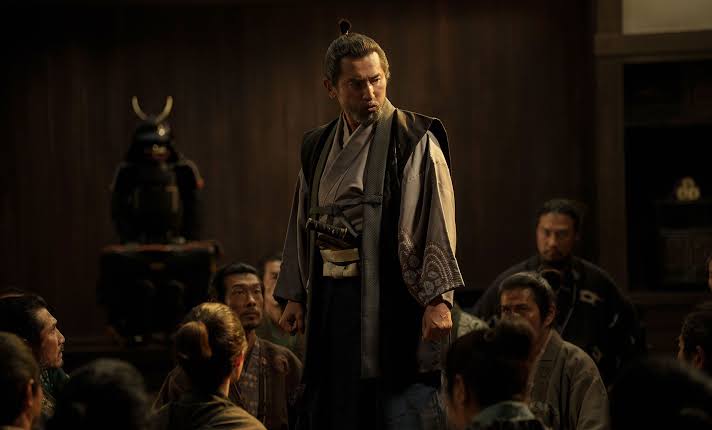
This is the premise of a multi-chapter mystery film set during the Samurai era of Japan. Araki Mureshiage is a faction leader surrounded by a powerful rival named Oku. His prisoner, whom he constantly turns to for advice, is Kuroda Kanbei, a clan leader loyal to Oku yet imprisoned by a man who refuses to give Kanbei the expected Samurai death reserved for those captured by enemies. Instead, Kanbei helps Mureshiage solve the murders, betrayals, and political conflicts that emerge. Yet there is still no way for Mureshiage to fully trust Kanbei, and there is even less trust from Mureshiage’s fellow leaders toward Kanbei, leaving them in constant conflict—not only fighting their enemy but also trying to ensure there is not a conflict among their own ranks that results in their downfall.
The style of the film is reminiscent of older films from the Samurai genre, especially those from the 1950s by directors like Kobayashi, whose Harakiri bears some strong resemblance to this new film. Both films are accompanied by the same minimal and careful camera movement, paired with wider frames. There are precise movements within the frame by the actors, and the film is shot with lighting that gives it a classic look, as if it could have been made in many different eras. The colour palette is more muted but also harbours interesting tones of browns, greens, and yellows. It often does not feature many bright colours, which makes any brighter colours that enter the frame stand out.
The story has a multi-part, novel-like structure that helps pace the movie. You quickly learn and understand the rhythm of the film, which gives each chapter its own murder or consequence to explore. There are some impressive battle scenes included if that is something you look forward to, and while they are never shot with particularly innovative angles or coverage and are probably lesser in scale compared to some of the greatest older Samurai movies, they are still well-made sequences.
The film does lack a certain novelty. Being made in the present day, it does not feel nearly as exciting as what many new and even long-working directors are doing in both domestic and international cinema involving murder mysteries and period settings. It feels like a nice return to some of the classic Samurai films of the past, but it mainly feels like a remix that lacks many inspiring changes, at least from a production standpoint.
The music is minimal but effective when it appears. The look of the movie also gives it a stage production quality through the way it is shot, and there is a serious feeling that does not attempt to capture realistic situations in the same way as some modern Hollywood Samurai projects or shows like Shōgun. Instead, it executes the specific style it is pursuing very well.
The consistent mysteries, betrayals, and intrigue surrounding this man trying to defend his one castle and defeat a much stronger foe are always interesting. However, it is not necessarily the most emotionally investing piece, as it keeps the audience at a distance from its main characters for much of the runtime. It creates plenty of moments of political intrigue and gets us invested in the conflict through our understanding of different characters and their motivations. Yet the film never gives us a strong enough reason to care deeply about the characters and their potential failures or deaths.
The mysteries and betrayals occurring within the castle are the central conflict. What makes us interested in these castle betrayals and the motivations of each character is how these actions could disrupt the actual protection they have and become the greatest threat to their survival. This makes the mysteries within the castle very compelling, while the murders themselves carry a mystical and puzzling quality that makes the investigation engaging.
The production design is very well done and interesting, seemingly fitting the time period while also clearly being built for the film. The sets have a stage-play quality, and while they do not always feel as lived-in as you might expect from a film of this scale, the variety of buildings and structures created for the story are impressive and visually engaging. The scale is especially notable considering the film’s likely modest budget.
The main core of the film remains the conflict of keeping this one prisoner alive. The idea of a man who only provides advice becoming essential to leadership is fascinating. Mureshiage wants to trust and rely on Kanbei’s cunning and intelligence, but he worries that Kanbei may attempt to create division among his own men. He must consider how Kanbei could use that trust to mislead him, especially because Kanbei earns his confidence by being correct about several important issues.
It creates an interesting conflict between killing your enemies and removing the threat they represent, or instead cooperating with them and using the fact that they are alive for your own benefit while knowing their presence could also create danger. It is a film about someone standing up for the value of human beings in an unusual and imperfectly ethical way, but one where you never truly doubt that he is attempting to do what he believes is right. Understanding what the right thing is, however, becomes increasingly difficult, and that uncertainty becomes the source of tension that sustains the film’s lengthy runtime.
The Samurai and the Prisoner is available in theatres on Friday, August 7th, 2026.