

Heel is deliciously insane.
Directed by Jan Komasa, Heel tells the story of Tommy (Anson Boon), a 19-year-old hellraiser who suddenly finds himself captured and dragged away in the night. When he awakens, he finds himself chained in the dreary basement of Chris (Stephen Graham), a husband and father who presents himself as… entirely normal. To Chris, this enforced incarceration is an opportunity for Tommy to turn his life around. But Tommy’s (justifiable) anger isn’t easily swayed and, in the midst of the chaos, the two men begin to forge the strangest of bonds: that of father and son.

In Heel, Komasa delivers one of the most warped explorations of the family unit in some time. Balancing furious intensity and dark comedy, each moment feels like a simmering pot that’s about to boil over. Through Tommy’s journey in Chris and Kathryn’s home, Komasa slices through traditional family drama with malicious glee, leaving the viewer often conflicted about their feelings.
In other words, it’s excellent.
With its own warped view of the world, Heel is surprisingly original. It’s not quite a coming-of-age story, nor is it about family trauma. Neither is it either pure comedy or horror. Instead, it’s a bizarre tempest of domestic cruelty and care that somehow pulls its themes together by its conclusion.
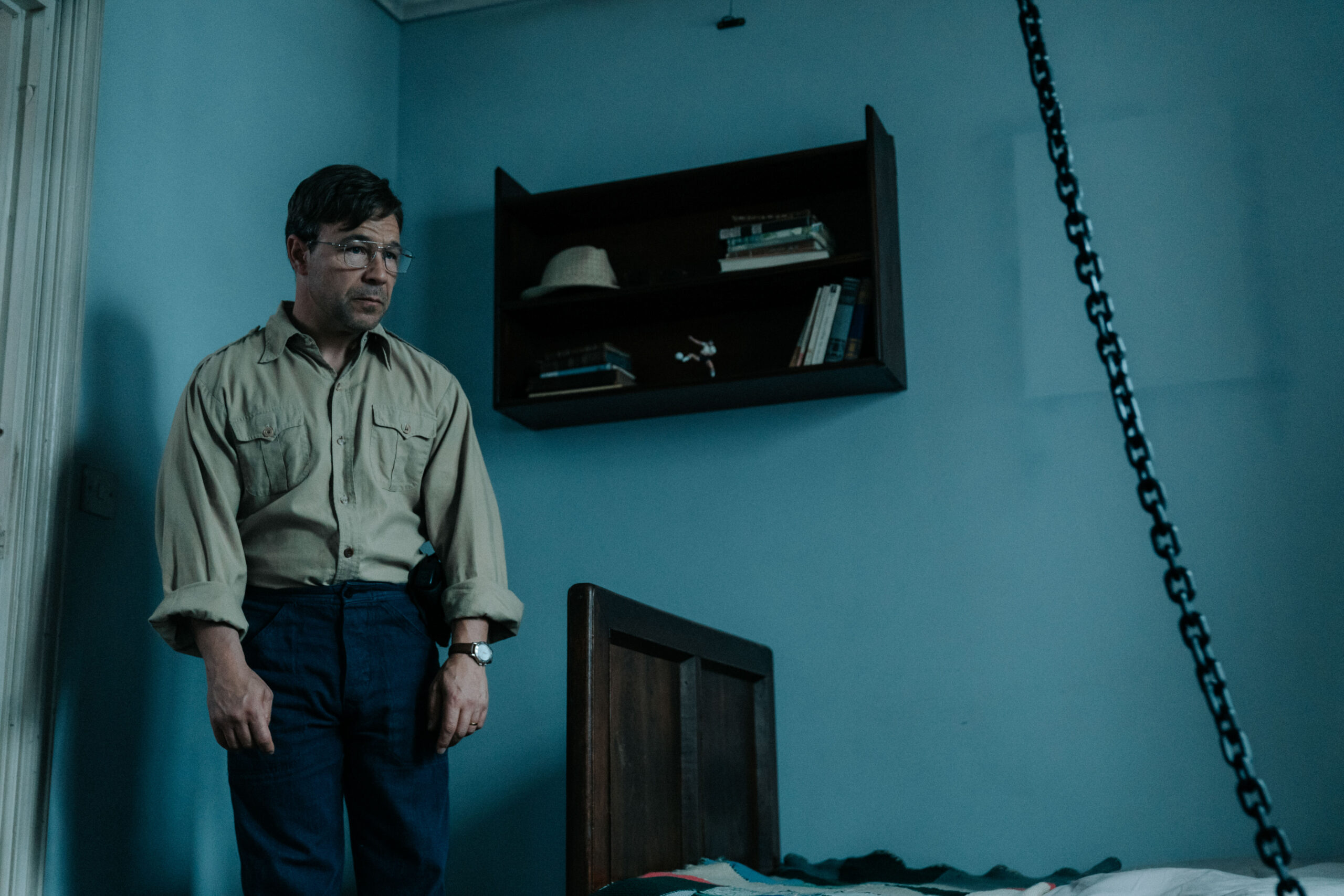
And Heel benefits from strong performances by Graham and Boon. The relationship between Chris and Tommy is almost inexplicable. Their conversations are fueled by hatred and admiration, torn between ferocity and trust. Yet it’s the way that Graham cooly approaches his young prisoner that somehow seems to help their interactions make sense.
For undisclosed reasons (at least, at first), Chris views his relationship with Tommy as one of disciplined parenting. Though his approach careens into the realm of madness, there’s a certain genuineness about the way that he speaks to Tommy that feels… loving. Even in his darkest moments, Graham leans into this aspect of his character, appearing calm and collected at all times. To Chris, Tommy is merely a misguided teen who requires boundaries to turn his life around and he treats him with a certain sense of respect. Make no mistake. His actions are horrifying… yet, for some reason, we don’t entirely despise his character.
And, almost strangely, neither does Tommy.

With charisma and rage, Boon walks a fine line in the role of Tommy. When we first meet his character, there’s no question that Tommy is utterly detestable. He epitomizes the worst parts of youth, careless about the well-being of others and himself. Yet, in the basement of Chris’ home, Boon begins to find the humanity within his most inhumane character. Once the victimizer, he is clearly the victim now. And Boon, without true repentance, somehow manages to break his character down into a sympathetic heel that even contains a glimmer of hope in his eyes.
It’s their relationship that keeps Heel on the very rails that it so badly wishes to jump off. Somehow, this endeavour in anarchy becomes almost charming as it attempts to cut through the layers of tension with a certain sense of compassion. Without saying too much, Komasa uses this setting as an opportunity to explore the effects of trauma, the complexity of family relationships and, most importantly, our need for connection.
To be clear, Heel is far from perfect. Despite its narrative focus, the subplot with the housekeeper threatens to expose its flaws. What’s more, it won’t be for everyone. (A film about torturing a teenager in the family basement isn’t exactly family-friendly entertainment.) Even so, the film is just so charismatic and bizarre that you just can’t turn away. The battle between care and corruption may be entirely twisted but it still manages to find hope for its murkiest characters.
But, make no mistake. It’s a very dark journey to get there.
Heel is available on VOD now.