A popular poster in dorm rooms when I was in college read, “War is not healthy for children and other living things.” It seems so obvious. Yet each generation gets a new chance to realize the truth of that statement. Case in point: The Voice of Hind Rajab, from director Kaouther Ben Hania. The film won the Grand Jury Prize at the Venice International Film Festival and is Tunisia’s submission for Best International Feature.
The film is a dramatization of real events. Because the story that it shows was a major worldwide news story at the time, I’m not going to bother with spoiler tags. Although what we watch is dramatized by actors, the voices we hear in the phone calls are the actual recordings of the people involved—including the child at the center of the story. This makes for some interesting editing involving the voices on the phone and the visuals of the reenactors. It also is a bit haunting to know that we are hearing voices of the dead.
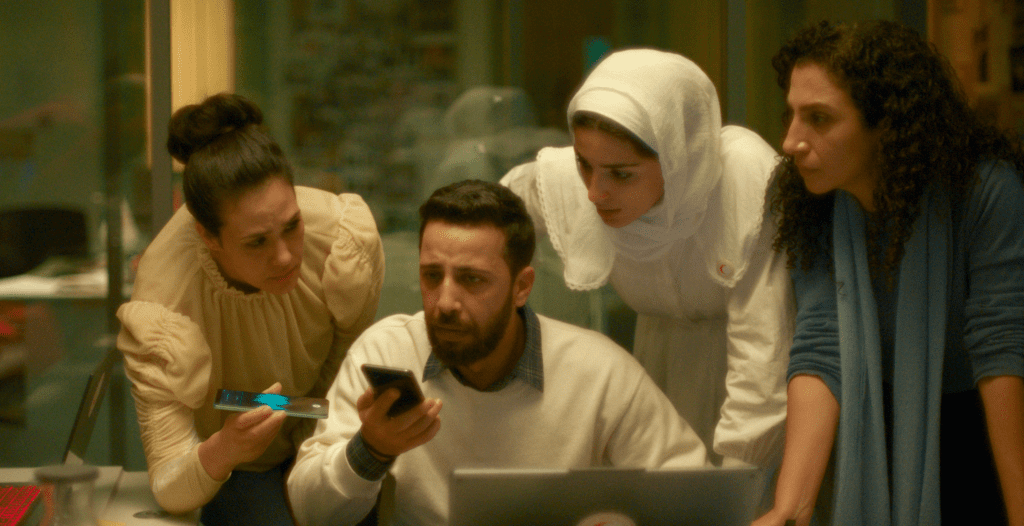
The film takes place in a Red Crescent call center in Ramallah, Palestine. Israeli Defense Forces have mounted a campaign in a town in Gaza. Hind Rajab, a six year old girl, is with her uncle and cousins as they are trying to evacuate the area. But when they stop for gas, a shell hits near them, killing all but Hind and an older cousin. The cousin calls for help and is transferred to the call center. When the cousin dies from her injuries, Hind begs the people there to come and get her.
The film is less about the rescue attempt than it is about the dynamics within the call center. They know there is an ambulance 8 minutes away, but before it can go to get her, negotiations have to take place between the call center and (after several indirect steps in both directions) the IDF. Three hours pass, Five hours. It begins getting dark, and Hind is afraid of the dark (especially with gun fire happening all around her).
The workers in the call center become increasingly frustrated, agitated, and begin to lash out at one another. Some break under the strain. All this time they try to keep the child on the line. Trying to calm her and encourage her. Keep in mind, she is trapped in a car, with bombs going off, guns being fired, tanks rolling by, and the corpses of her family beside her. For hours.
It may be impossible for us to truly imagine the horror that Hind Rajab suffered. But we can empathize with the call center workers. As we watch we want nothing more than for the safety of this six year old child. We want to comfort her. We would do anything to save her. And we get just as frustrated with the situation, and even more the middlemen in the negotiations—people for whom this little girl is just a minor complication in the war going on.
This is the story of the tragedy that is inherent to war. Even if one were to take the position that Israel was justified in all they have done in Gaza, the death of Hind Rajab (and so many other children) can never be deemed acceptable. To use the term “collateral damage” is sinful in that it dehumanizes the victims—all of whom are precious children of God. But what is the real sin within this story is not just the death of a child (and those who sought to save her), but the very nature of war which cannot be waged without such atrocities.
This film should definitely lead to discussions about the war in general and in Gaza, in particular. Because the world is so intertwined, this is not something that happens far away. We are all involved in this tragedy to some extent. The question becomes what will we do about it going forward?
The Voice of Hind Rajab is in select theaters.