
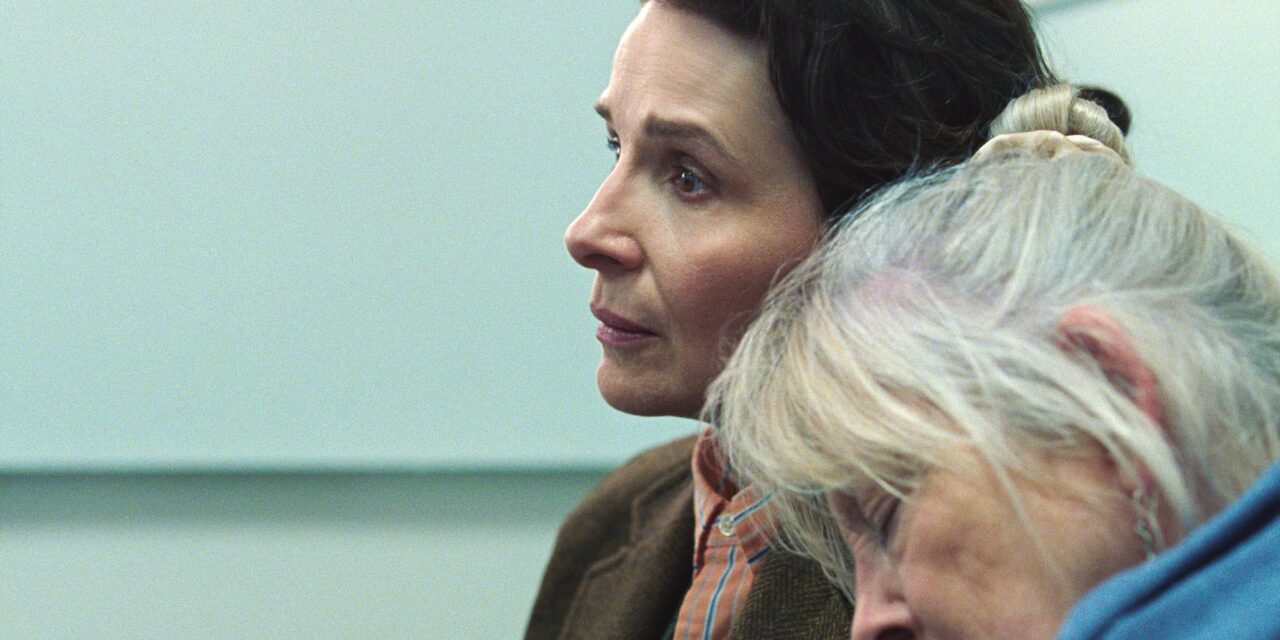
“I don’t know how she experiences love now.”
It’s hard to understand someone else’s experience. When that person is deep in dementia, it is even more difficult. Queen at Sea, the sophomore feature from director Lance Hammer, examines the moral conundrum involved with making decisions for those who are not capable of doing so themselves.
The film opens with Amanda (Juliette Binoche) and her teenage daughter Sarah (Florence Hunt) arriving at the home of her mother Leslie (Anna Calder-Marshall) and stepfather Martin (Tom Courtenay) to find Martin having sex with Leslie. Amanda is upset because Leslie has advanced dementia and the doctor has said she’s incapable of giving consent. When Amanda calls the police, it quickly escalates into a rape investigation and Martin’s arrest. Martin is adamant that Leslie not only consents, but initiates sex.
The film is not so much about sex and the elderly as it is about how to find what is right in the complicated world of caring for someone such as Leslie. Who should make decisions for Leslie’s life?
Martin is a loving and caring husband. He feeds her mouthful by mouthful while he eats with her. I was touched by a scene in which all that happens is the two of them taking their morning pills. He has devised a ritual for this because it is what works so he can take care of her.
Amanda also loves her mother. She has come to London while on sabbatical to be closer to her during this time. She has power-of-attorney for her mother. Amanda’s own life is complicated. Her husband has left to teach in Canada. Her daughter Sarah is having her own emotional and sexual awakening. Amanda is of that middle generation that has demands from both parents and children, but has no one taking care of her.

Add to this the institutional response of police and social workers who get involved. Can the impersonal bureaucracy be the answer? Will things only be worse for Leslie apart from those who love her?
The film is not so much a competition between these options as it is about the effort needed to bring all the ways of loving into the situation. Still, we seem to know that all the efforts are doomed in some way.
While these dilemmas drive the plot of the film, it is the characters and their personal struggles that give the film its soul. Martin and Leslie are a couple who have had many years of love. Martin certainly remembers them, but what of Leslie? That is a key question. Because of the dementia, no one has any idea what Leslie experiences-not only about love (as in my opening quotation), but about everything she encounters. Courtenay and Calder-Marshall are outstanding in their portrayal of this couple in the midst of such a great unknown.
Personally, my wife and I are of an age where we know we need to watch out for each other a bit more than in years past. There are scenes that I recognized as possible changes in our life. I understand Martin’s deep caring for his wife. He can’t image anyone would be as good as caring for her as him. He may well be right. I also understand how lost he becomes when not able to care for her. That role of caregiver has come to define his life.

A key part of the film is the question of what makes a person? To what extent is Leslie still a full person? To Martin, she is still his wife and he loves her. To Amanda she is still her mother and she loves her. But we never are sure where Leslie is in all this. She may or may not know who Martin or Amanda are anymore. Is she still wife and mother? Perhaps we may wonder who we are apart from the relationships that define our lives.
Queen at Sea in in select theaters.
Photos courtesy of Greenwich Entertainment.