For the fourth time in sixty years, the events of the post-World War II trials at Nuremberg are receiving cinematic treatment. The first time, in 1963, director Stanley Kramer (High Noon, Inherit the Wind, The Defiant Ones) had legendary actors like Spencer Tracy, Burt Lancaster, and William Shatner at his disposal. This latest adaptation takes a big swing at the evil in men’s hearts as related to the Nazi atrocities during the Holocaust, and brings in another set of big names to shine a bright light on the battle between good and evil.
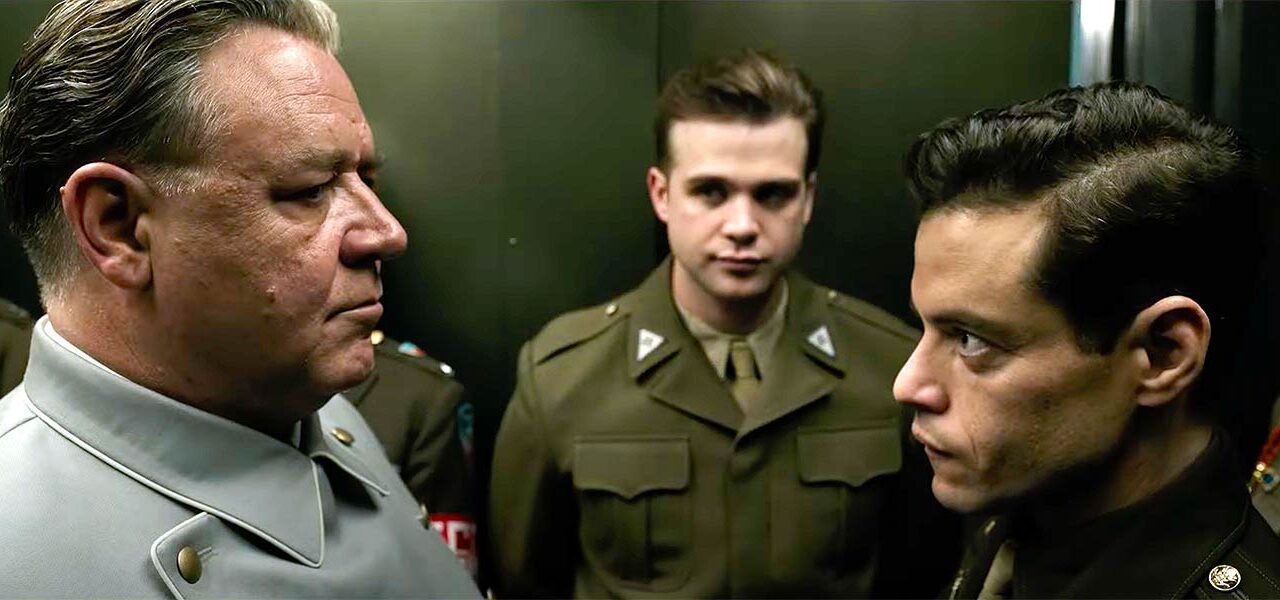
Representing the American sentiment against the Nazi leaders who’ve been rounded up post-war, Michael Shannon’s Robert H. Jackson wants to put the likes of Hermann Goring (Russell Crowe) on trial for the world to see, rather than letting him be murdered without any proof of his wrongdoing. To get the evidence (and psychiatric evaluation), Army psychiatrist Doug Kelley (Rami Malek) is sent in to get to know Goring and the other prisoners, and evaluate them.
Under the direction of James Vanderbilt (Scream, Zodiac, Amazing Spiderman), Shannon, Crowe, and Malek are joined by John Slattery, Colin Hanks, Leo Woodall, and others. The period piece is smooth, with significant amount of dialogue and discussion of right and wrong, leading up to the trial that will decide the fate of Goring and the way the Nazis will be remembered. It’s grounded in reality, based on the book about Goring and Kelley by Jack El-Hai, The Nazi and the Psychiatrist.
While previous iterations of the story focused on Jackson or other lawyers/judges, Nuremberg looks more closely at Kelley and his relationship with Goring. It’s terrifying, and realistic, in showing how Goring’s personality and charisma nearly derail Kelley from his purpose. It’s a character study, but also a physical reminder of the battle between the “angel” and the “devil” on our shoulders. Ultimately, it’s aimed at the real war, the one between good and evil, that plays out in different forms in our lives whether we acknowledge it or not.
Compelling, moving even, the film shines a light on patterns that play out in human behavior, the way group think works for good and bad. It’s actually as much a warning about our future as it is a reminder of the past. Hopefully, audiences will be entertained by the knockout performances, but also called to action to prevent these evils to replicate in our lifetimes or stand against them as best they can.
Nuremberg is in theatres on November 7th, 2025.