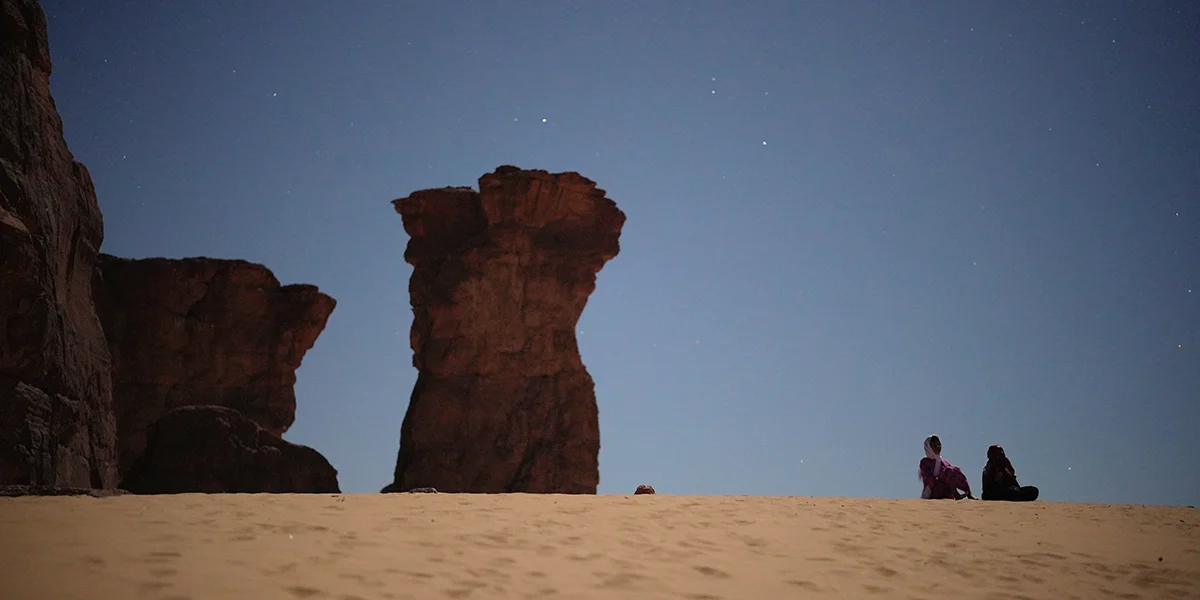
At TIFF ’26, I sat down with Mahamat-Saleh Haroun to talk about his film, Soumsoum, The Night of The Stars. Our conversation, which covered origins, connectedness, and African storytelling, is below.
*Interview has been edited for length and clarity.
Seun: Hello Mahamat-Saleh. Congratulations on making your film, bringing it to TIFF, and having people see it. How are you feeling about that?
Haroun: Well, I was really delighted yesterday after the screening. Toronto is so far from Chad, you know? And it seemed that people enjoyed the film, and I was happy about that. It’s just like this universal story can talk to everyone. It was a reflection about life, memory, all big things, and I’m really satisfied by the reaction. It was really great.
Seun: And what was your inspiration for the film? Why is this a story you wanted to tell?
Haroun: Well, I have several reasons. The first one is, I wanted to talk about these women that we consider a ‘wizard’ in Chad because we think that they have a kind of mysterious power – they see the future, they have visions, et cetera. And I wanted to mix that with the idea of this place, the landscape of Ennedi. People believe that the mountains are eternal – and they are right for that- and they believe that after our death, we become mountains because we have to keep the memories, and we have to protect the people living around there. So, it’s a kind of tale, you know, a legend. And I wanted to mix that in a reflection in this place, which is not far from where we discovered the first human being on Earth. That means we all belong to this place, and so that’s why I wanted to show this place, and the connection.
Everywhere I have screened the film, people are moved, and it’s because this place is the place where everything started, so everyone belongs to this place on Earth. And I think you can just feel something, because this landscape is the beginning of our history. I had people coming from France, and from Belgium at the screening, and they were all fascinated. There is a kind of relation that you can’t explain. It’s just like maybe something you have seen in a dream, you just have this feeling that you know this place.
Seun: Yeah, you can definitely feel that in the film. And to that point, this film analyses how there are old ways of life and new ways of life, but sometimes the new ways erase the old ways. And for the main character, Kellou, she embodies that and is going back to that. Do you think every person has that kind of innate or embodied connection to the old ways?
Haroun: Yes, I think that we have all this connection. We are in a kind of race of doing things and so we don’t take care of what surrounds us, but I think that everyone has this capacity. It’s just like when someone is lying to you. We all have this possibility, to know “someone is lying to me.” So, I think everyone can just- if you take time, if you have some silence in your life, it definitely is not lost.
Seun: That leads me to my next question. Films like yours do a good job of helping us remember the old ways, because they capture the physical spaces. What are other ways we can connect back to those things?
Haroun: That’s the mystery of creation of images, you know? But I think that in this film, particularly, there is something which has to deal with the landscape, and with these places, I can’t explain it, you know, but it’s the intention you have in filming a place. And that’s a question of feeling, because we can shoot, just like, these flowers, [points to flowers beside us]. We can give a camera to 100 people, and we will not make the same film? So, this power is in your intention, but I can’t explain it. It’s really the mystery of making an image. We have to be humble, because creation has to deal sometimes with things that are more important than us, you know.
Seun: Yeah, yeah. I agree. And I really love those shots of the Ennedi Plateau. They’re so beautiful, especially the carvings and the rocks to show the civilization that was there. Can you talk to me about filming that? What was that process like?
Haroun: Well, you know, in African cinema, it’s just as if our history started with colonization, but we have existed before, and we have stories, and I wanted to show the reality of that. I know that in Europe, in some places, people thought that it was artificial intelligence. Even that, which is our only reality, people don’t believe. They think maybe it’s just not real. And I wanted to show the reality of our past that we have in every country in Africa. I wanted to escape from this eternal dialectic between the colonized people and those who have colonized us, because it’s always just saying, “you are responsible of that. You did that.” I wanted to show that we existed before. And in this place, you have the first human being. History started there. So, I wanted to remember that.
Seun: Yeah. And I’m Nigerian–
Haroun: Oh, really?
Seun: Yes! So, when I was watching, I definitely felt that connection. There are many stories before colonisation.
Haroun: Yeah, absolutely. Yeah. I love Nigerian theatre, by the way, because you have this culture that we don’t have in Chad, and a lot of countries don’t have. But Yoruba theatre has something… I mean, its patrimony. So you can explore and make films, that’s what Nollywood is trying to do. And that’s very important. That means you existed before, and a lot of people think that our story started with colonization, which is not the truth.
Seun: At the end of the film, Kellou’s mother tells her, “you are free.” What does freedom mean to you in that context?
Haroun: Freedom in this context means that you don’t to have to give credit to what people are saying. You know that you’re not, for example, a killer. So, if people in the street, say, “Ah, she is a killer”, or “she is a stoner”, or something like that, being free is just not concerning yourself with all those things. That’s liberty for me. That’s freedom.
Seun: It’s like taking control of your own story.
Haroun: Yeah, of your own destiny. And I believe that the most important freedom is also this kind of achievement of yourself. As long as you achieve yourself without, you know, killing someone, without frustrating someone, without doing any bad thing to another person, I mean, it’s not a problem. If I’m happy, you should be happy for me. That’s freedom for me.
Seun: My last question for you is, what do you hope people who watch this film take away, especially people from Chad, people from Africa, who will be watching. What do you hope they feel?
Haroun: Well, for people from Chad and from Africa, what I would like them to understand is that we belong to the same ancestors, and that we don’t have to keep religion imported from abroad as part of our identity more than being from Africa. You’re from Nigeria, you know that you have a lot of Muslim people killing people because they are Christians. We have to remember that we started and are coming from the same place, from the same ancestor, and then we have colonizers coming here and dividing us. If you prefer following the way of your religion coming from abroad over being African, that means you accept that you are divided, and you are kind of alienated, you know? And I want people to remember that. So, history is very important to remember that you and me, we belong to the same ancestors. If you’re Muslim, and me, Christian, it’s not a problem. It should not be a problem. That’s what I want people to learn. We are one. As long as something is dividing us, it’s not good. It’s wrong.
Seun: That’s beautiful. Thank you so much. Congratulations, again.
Haroun: Thank you to you.
Soumsoum, The Night of The Stars is playing at TIFF ’26. For more information, click here.