
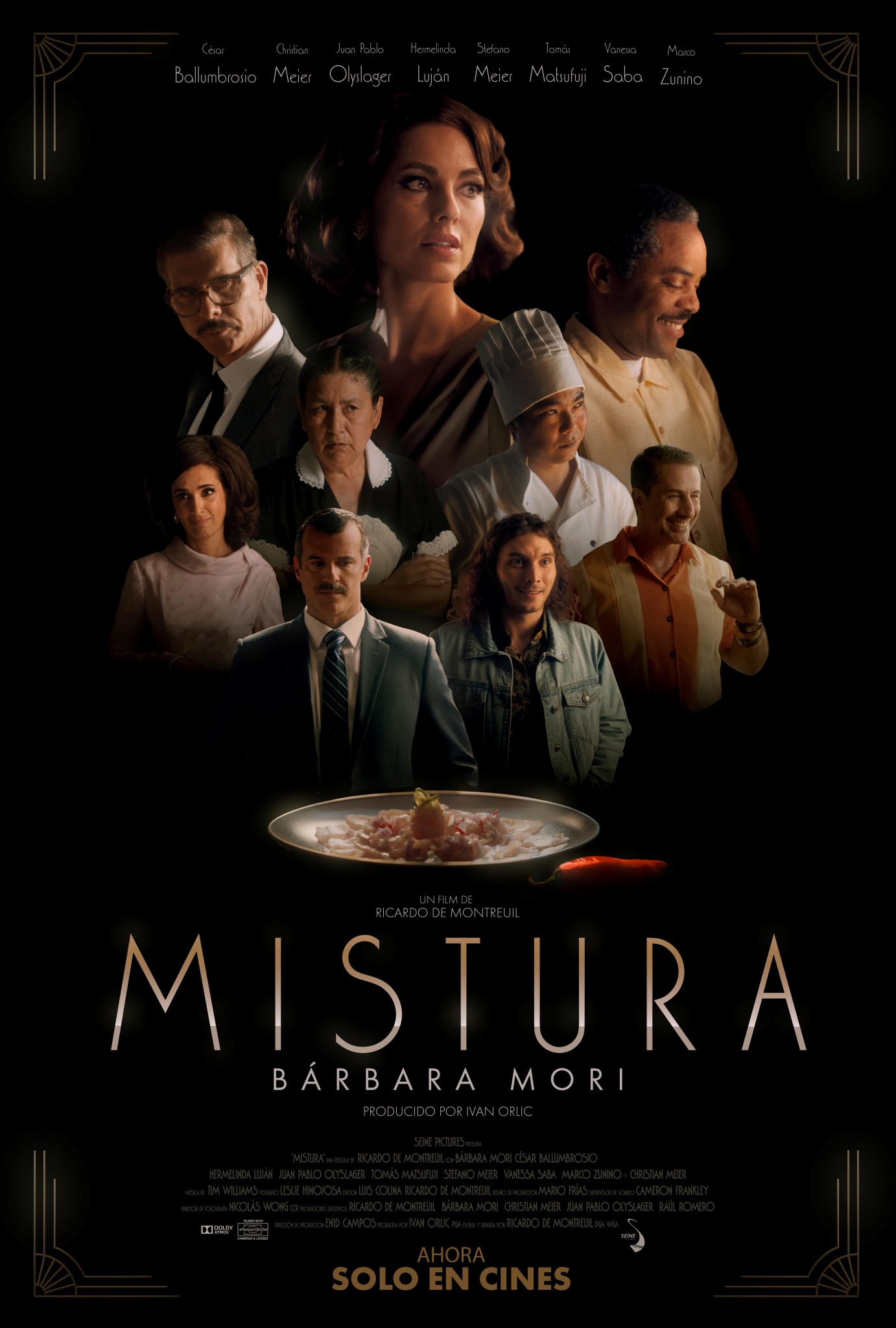
Fusion cuisine can be quite tasty. It is also an example of way various cultures make each other better. Ricardo de Montreuil’s film Mistura offers us a look at how we may find new life out of old ways when we allow ourselves to be fed in new ways.
Set in 1965 Peru, the story follows the struggle of Norma Piet (Bárbara Mori), whose husband has left her for another woman on New Years. Norma is French-Peruvian, having grown up in the country while her father was the French Ambassador. She has had a life of privilege. But now, after her husband’s betrayal and abandonment, she is left on the outside of society. She can no longer go to the Country Club, because women can’t be members. She has no real way of paying for her living expenses. Before long, she lashes out at her housekeeper who she falsely accuses of theft. Only her Afro-Peruvian driver, Oscar (César Ballumbrosio) sticks with her through her trials. At first, he does so out of loyalty but, as time passes, the two come to appreciate each other in new ways.
Norma is not an easy person to get along with. She is proud of her bourgeois roots to the point of snobbishness. When she decides to open a French restaurant in her home as a way of making a living, she expects raves at such wonderful food. She gets yawns. It is only when her Japanese-Peruvian chef and Oscar begin making some food that combine Peruvian elements that the restaurant becomes successful. In the process, Norma learns that there is much to be appreciated from the may kinds of food that begin to come together—and more, in the many cultures that blend to make Peru what it is.
In part, the film speaks to the oppression of society. In the background, we see news stories of protests against the oppressive government. That adds a little political flavor to the mix. It is much more about the oppression women at the time faced, if they were not tied to a man. It is no coincidence that the story begins on New Years (marking a new life for Norma to face) and the Peruvian Independence Day (when Norma has come into her own and has discovered her power).
The real message of the film is found in the discovery of the way different cultures can blend to make the benefit of the whole. The title is a misspelling of the Spanish word mixtura (mixture or blend). Norma’s journey takes her from being a cultural chauvinist to celebrating the diversity that she and her staff create when they make food reflective of their differences.
This is the part of the story that transcends the Peruvian setting. At a time when political forces in the US and other nations push against immigration and more diversity, this film speaks of the gifts that diversity brings into society as a whole. The easiest way to demonstrate such gifts is the way food from different cultures adapts to society—and can blend with other foods to create something new. So too, with people, they adapt to our culture—but they also being welcome gifts that can change us.
Perhaps I should get some Thai tacos for lunch.
Mistura is in select theaters.