
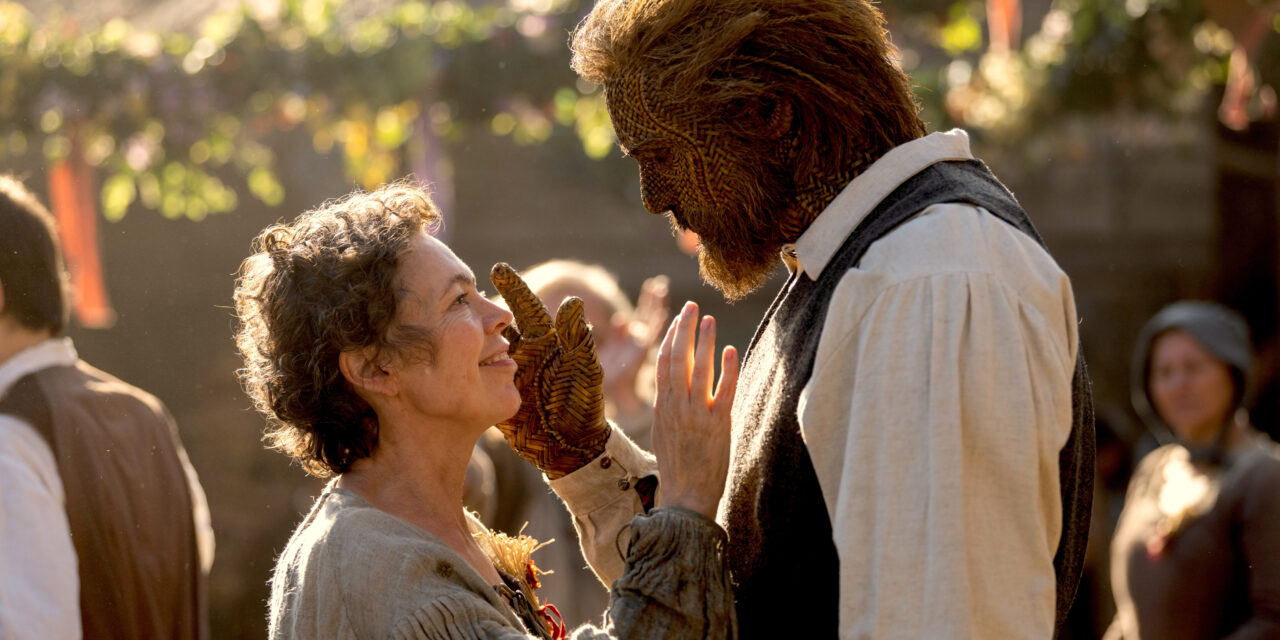
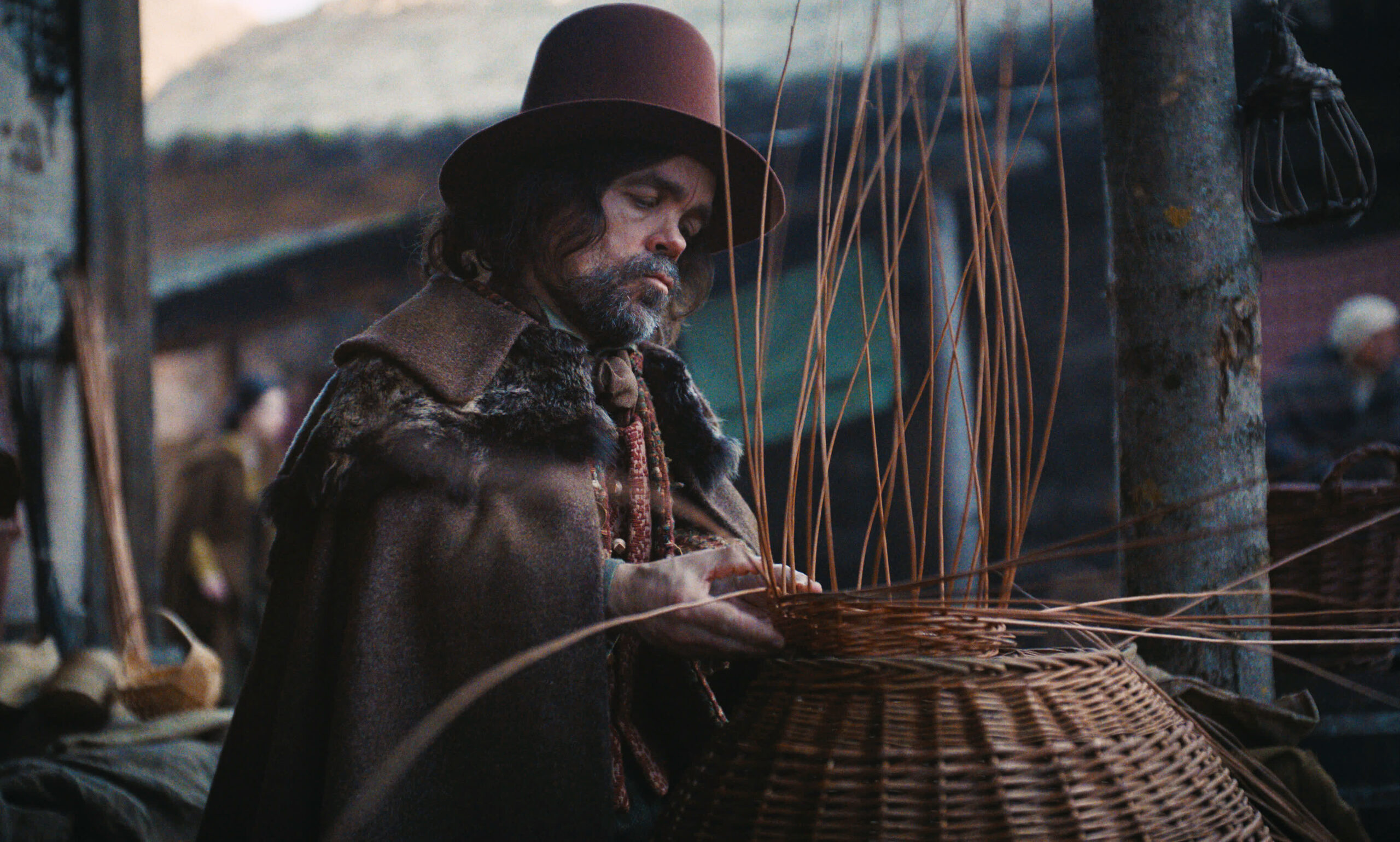
Wicker follows a most miserable and lonely fisherwoman (this is also her name), played by Olivia Colman. With marriage season in full swing, she sees that while she hates the clear restrictions of other marriages in her village, she still wants to have a partner, someone to love. Thus, she employs the supernatural skills of the local Basket Weaver (Peter Dinklage). At first hesitant, the Basket Weaver dedicates himself to crafting a husband for her, pledging that he will make him a creature of free will. The result is Wicker Husband (Alexander Skarsgård), whose presence in the village soon provokes anger and suspicion from the women, led by Tailor’s Wife (Elizabeth Debicki), whose actions may prove that this magical life for Fisherwoman has more than a few complications.
The film is a twisted fairy tale that becomes part of the pantheon of films that look to pick apart the hypocrisies and miserable nature of marriage and patriarchal society. By looking into the past and the foundations of marriage, we see why it can be considered so flawed. You also see how some of the behaviours of men and women from the past repeat themselves in our current society in ugly ways.
The film is often funny, utilising lots of wordplay and puns based on the unique fact that the characters are tied to their industries. There’s a fisherwoman (fish pun), a baker, (baking puns and jokes about bread), and so on.
The production and building design are very good. This village feels distinct, reminiscent enough of images and renderings of medieval or early Renaissance villages in Europe, but still different enough not to be attached strictly to one country’s setting. All the period aspects are very convincing and allow you to suspend disbelief with ease. It’s very easy to place yourself in the past with this film, even if you are not sure exactly what period you are in. That is exactly the point, though, so it works wonderfully.
The music is just as fun as the film’s dialogue and sense of humour. It complements both very well, with energetic music that gets you excited for the story and for more to happen. But it also pulls back and is fitting for some of the film’s more emotional and tragic elements. It’s a delight to listen to when it wants to be fun, which is often. You wish other films that aim for fun had music with this kind of energy.
There are lots of jokes about the men’s foolishness and their inability to actually treat marriage as a partnership in which one loves the other and that love is returned. They do what they are good at while offering comfort and compromise to help each other. This is really the strong core of the film: what happens when someone dares to distrust the generally depressing, archaic patriarchal structure that rules over the town and dictates how society works?
Men work until they are considered worthy enough to marry another working man’s daughter, and then they are chained together, with the husband hoping to get some sex and a well-kept household. The woman gets a life of restriction. These restrictions cause the women to suffer and feel unfulfilled. But then, as one woman frees herself from this in a fulfilling way by having a partner who provides the romantic and partnership qualities sought in marriage without the restrictions, jealousy and suspicion, especially from one woman, threaten to tear the village’s normalcy apart.
The question is whether it will all be forgotten.
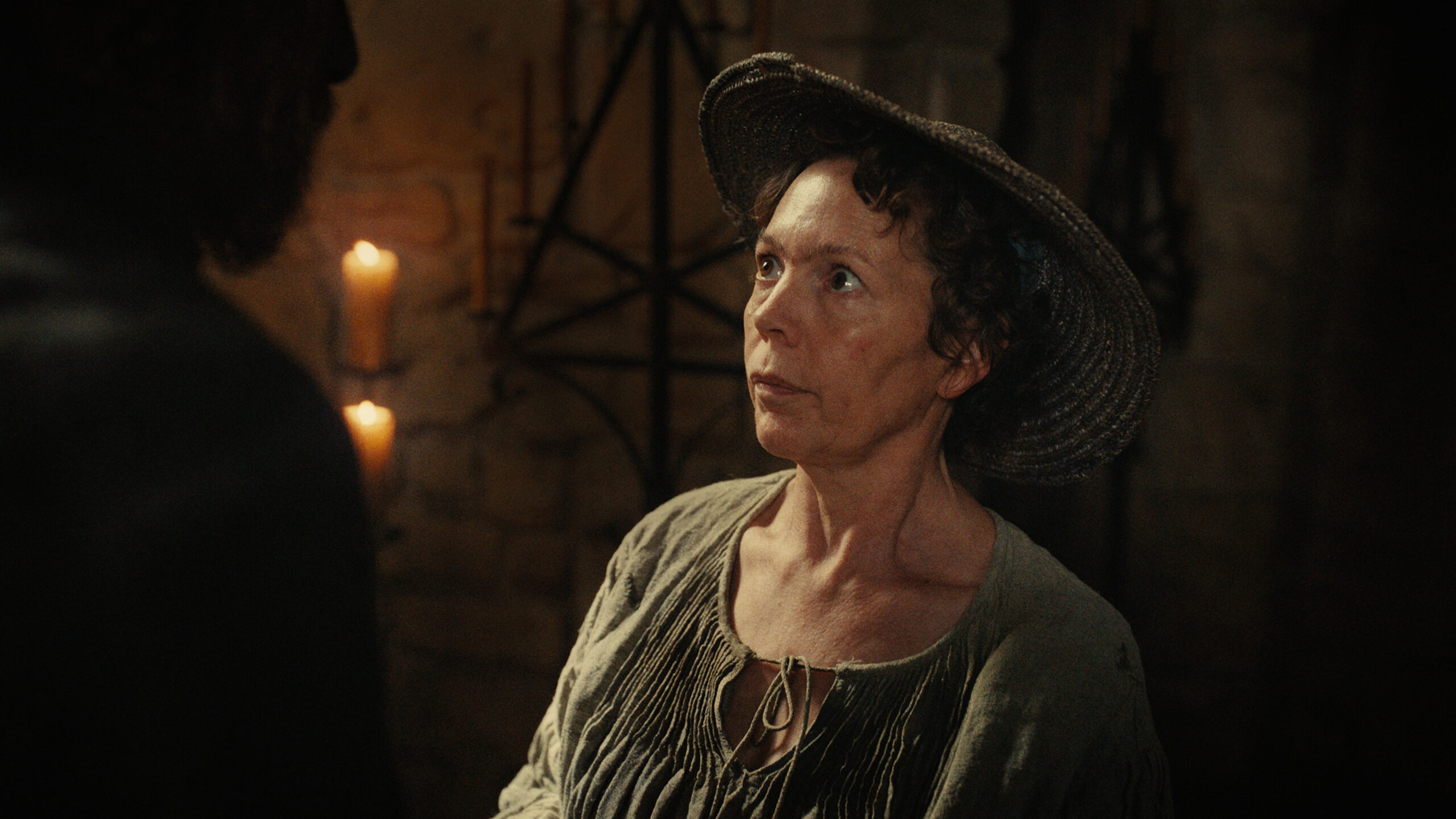
Olivia Colman appears in Wicker by Eleanor Wilson and Alex Huston Fischer, an official selection of the 2026 Sundance Film Festival. Courtesy of Sundance Institute | photo by Lol Crawley.
There are lots of funny moments. They are clever, but the majority are not written so uniquely or comedically that you are caught off guard in a way that provokes strong laughter. Still, it’s skillfully written and put together as a complete story. The way the film breaks down the novel it’s based on works very well for the pacing of the storytelling and the entertainment factor. The film divides itself into chapters and continually introduces new ideas that make the story more complex and interesting. Scene to scene, there aren’t many moments that truly impress or are more profound than most films with similar ideas, but every scene provides value and is enjoyable to watch.
Wicker presents an extremely well-executed world with a more limited scope that still manages to fill an entire town with personality and different characters. Even Richard E. Grant, whose character is mostly spoken about, establishes a clear sense of who he is in a short scene. Each person is given a distinct personality associated with their trade, which, when combined with the film’s clear commentary on partnership, patriarchal leadership, and social angst, helps make every scene feel full of life. Each character provides value, and even scenes that move away from our main leads remain strong and worthwhile.
The characters’ names being their jobs also helps drive home the point of how these people are restricted to their roles in the village, but the film’s scenes help show that they are more than those titles.
Wicker is available in theatres on October 23rd, 2026.


