
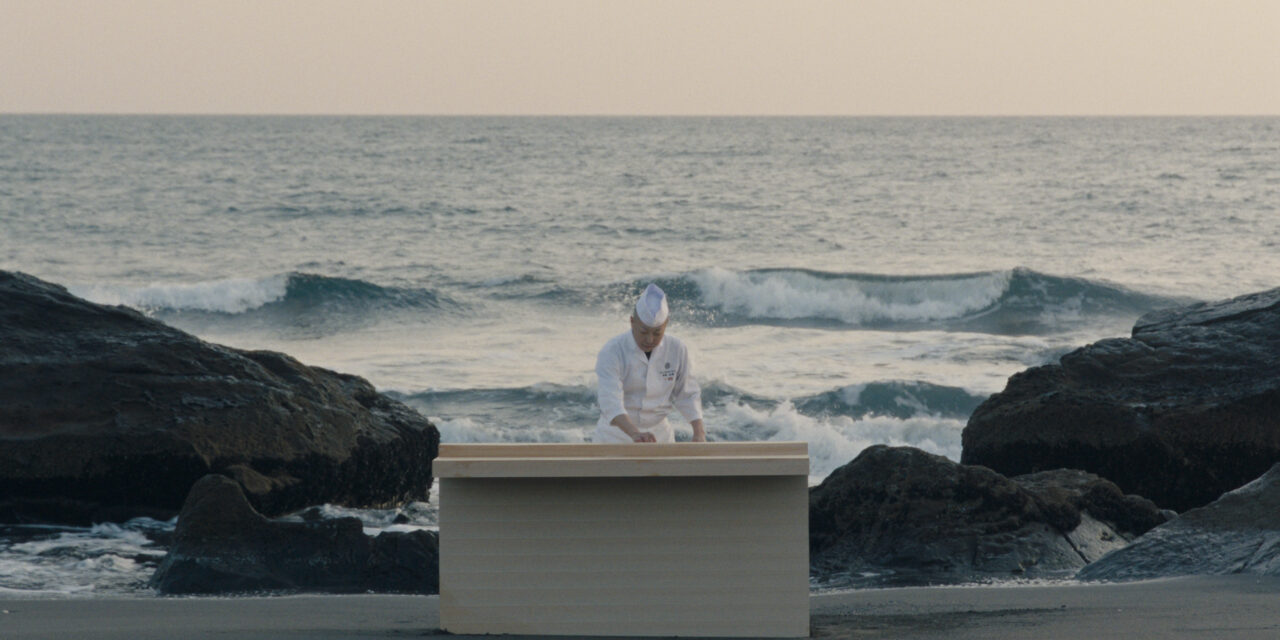
Every meal is an opportunity to create perfection.
Directed by Jamal Burger and Jukan Tateisi, Still Single follows Chef Masaki Saito, Toronto’s first (and only) two Michelin Star chef. Although Saito began in rural Hokkaido, his desire to perfect his meals helped transform Toronto’s fine dining landscape. Intensely building every morsel to its maximum appeal and taste, Saito is a man of expertise and creativity. However, his approach to Omakase dining also leads to an intense lifestyle that fuels his culinary spirit.
In Single, Burger and Tateisi keep their film focuses primarily (though not exclusively) focused on two areas: the kitchen and the home. These are Saito’s two primary spheres and, although he moves through others, the film draws a direct connection between the two worlds. For Saito, the kitchen is home. And home seems to be a place where he yearns to be back in the kitchen. This relationship is key to Still Single as Burger and Tateisi lean into the ways that they seem to interact with one another.
However, its Saito himself that is more compelling than the magic of his cuisine. In many ways, Saito is a mystery wrapped in an enigma. As they follow him around with their cameras, Burger and Tateisi give him the opportunity to share his dreams and goals in his own words. As a result, Saito’s journey feels entirely authentic. He’s a man of honesty, willing to share his feelings without filter.
However, Saito’s character becomes more fully fleshed out when we get pictures of him from other people. Every interview with former staff offers a slightly different perspective on the star chef. To some, he’s a mentor. To others, he’s a friend. And, to all, he’s demanding.
But the soul of Single is Saito himself.
Through numerous conversations, Burger and Tateisi allows Saito to paint his own perplexing portrait of himself. He’s charming, aloof, obsessive and perfectionistic. As such, Saito comes across as a mixture of opposites. There’s an undeniable charisma about the man that makes you wonder why he spends so much time alone. But we also watch him disconnect from family and friends, we wonder how he can work with anyone. He is driven by success but doesn’t entirely know if there’s a level of it that will truly satisfy him.
Though, above all else, Saito is a man of passion.
Every decision he makes in the kitchen is meticulously designed to elevate his product. Whether it’s the quality of rice or understanding the relationship between ‘animal energy’ and ‘amino acids’, Saito uses everything at his disposal to ensure that his food is as close to perfection as possible. For him, food needs to appeal to the 1% so that that it can appeal to the 99%. There’s an artistry in the appeal that Saito brings to life, creating delicious experiences for everyone who partakes.
What’s more, Saito acknowledges that food can be almost a spiritual experience by drawing people together. There’s something powerful that happens around a meal and Saito believes that his food does more than satisfy. It creates emotional bonds. (“Like Japanese culture, eat together like a family,” he claims.)
Which, again, makes Saito’s solitary life worth exploring. He seems to revel in his individuality yet also remains committed to building special moments for others. He loves family but the film shows moments where he struggles with his own family relationships at home. He is a man of connection. He’s also a man who stands alone.
But, somehow, it’s that contradictory representation that makes Saito so compelling. In Still Single, we applaud his passion for perfection. Nevertheless, the film also seems to ask if he will ever be satisfied in his pursuit. His humanity serves as a counterbalance to his superheroic efforts in the culinary world, making for a delicious character portrait.
Still Single is playing at TIFF Bell Lightbox on Friday, December 6th, 2025.