
In The Lowdown, truth is hard to come by.
Created by Sterlin Harjo, FX’s new series, The Lowdown follows Lee Raybon (Ethan Hawke), a citizen journalist obsessed with truth who can’t seem to keep himself out of trouble. After local magnate Dale Washberg (Tim Blake Nelson) commits suicide, Lee can’t help but feel like something’s off. And the further he digs, the more dangerous things become for him, proving that he’s on to something big.
Coming at a time when the concept of ‘truth’ and the media taps into the cultural zeitgeist, The Lowdown feels exceptionally timely. Featuring a lead character that refuses to back down from bullies in his quest for the facts, the series carries a sense of furious accountability that feels necessary. For Harjo, the notion of being honest about the dark corners of history was exciting for him to explore through the lens of Tulsa, Oklahoma.
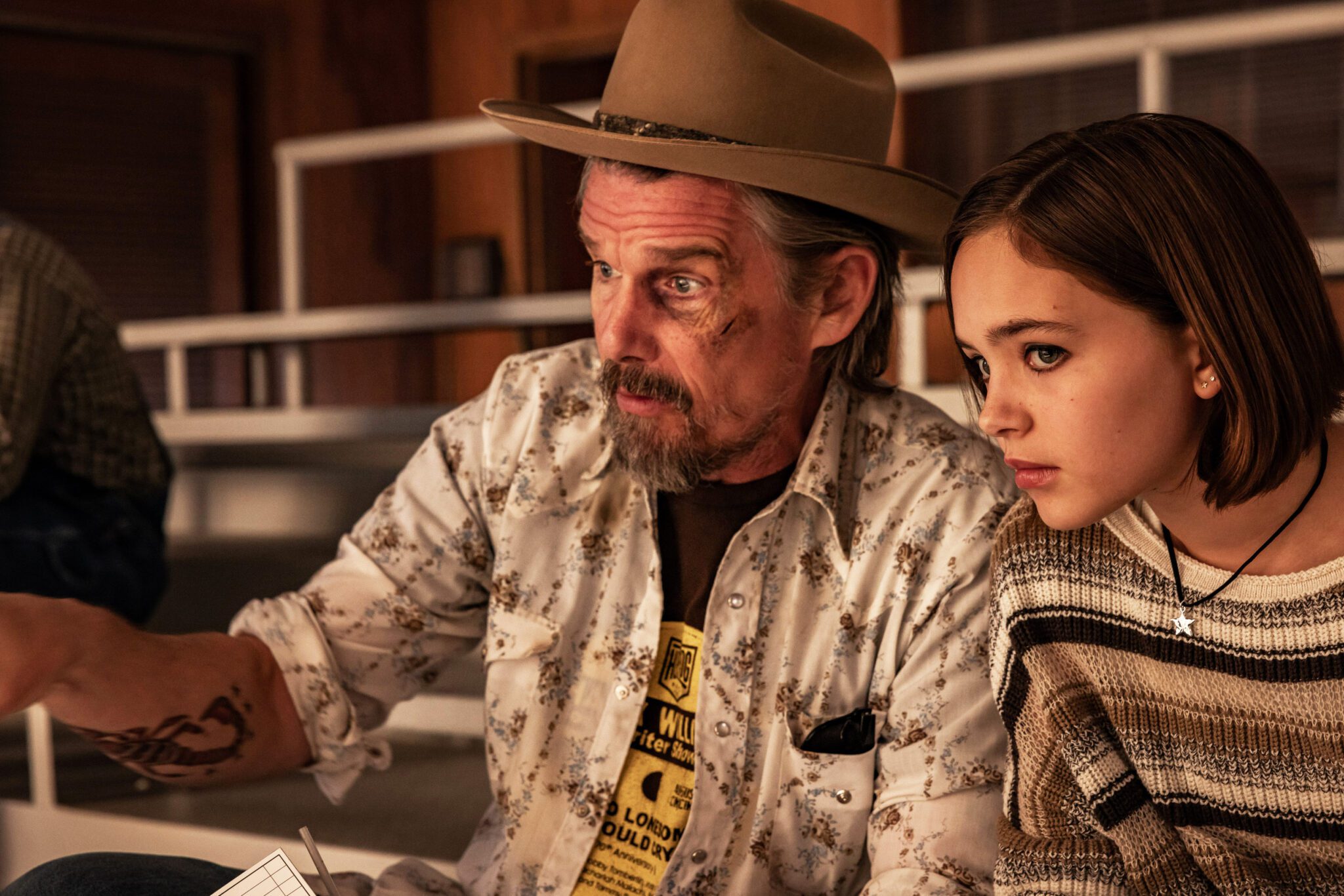
FX’s The Lowdown — Pictured: (l-r) Ethan Hawke as Lee Raybon, Ryan Kiera Armstrong as Francis. CR: Shane Brown/FX.
“I think that, you know, Tulsa in general and places like Oklahoma in general, get kind of overlooked,” Harjo points out. “And, you know, this show sort of talks about the nuance of the human experience and also the nuance of places like Tulsa. I think that showing that, like we all [have] a need for the truth, and we’re all very much more alike than I think we are different. Oklahoma, in general, is a very diverse place. But it also has this dark history to it. And it’s sort of like, for me, a representative of the whole country. You can kind of look at the history of Tulsa and map it to the history of the country itself. And right now, in Tulsa, you have this sort of healing that’s happening. And that healing is coming from telling the truth about the history of that place.”
“You know, the history of the indigenous people there. Tulsa’s a native word,” he says. “It’s a Muskogee Creek word that comes from the word Tallahassee. And you know the word Tallahassee because it’s in Florida and it’s down in the Southeast. And that’s because we were moved by the US government and marched to Oklahoma. And so, Tulsa and Oklahoma in general kind of represent this country in a way. And I think that also, you know, represent the healing. And I think that’s a big thing to talk about with a TV show about someone’s getting beat up for the truth, but I think it’s all in there… It’s about healing because of truth and fighting for the truth and the idea that truth is a noble thing to fight for.”
In this spirit, it’s worth noting that Lowdown feels like a modern Western in many respects. Set in dusty Oklahoma, Raybon almost feels like the unofficial sheriff dedicated to ‘cleaning up this town’. However, more than this, Hawke recognizes the complicated history of the western genre and the ways that it continues to reinvent itself.
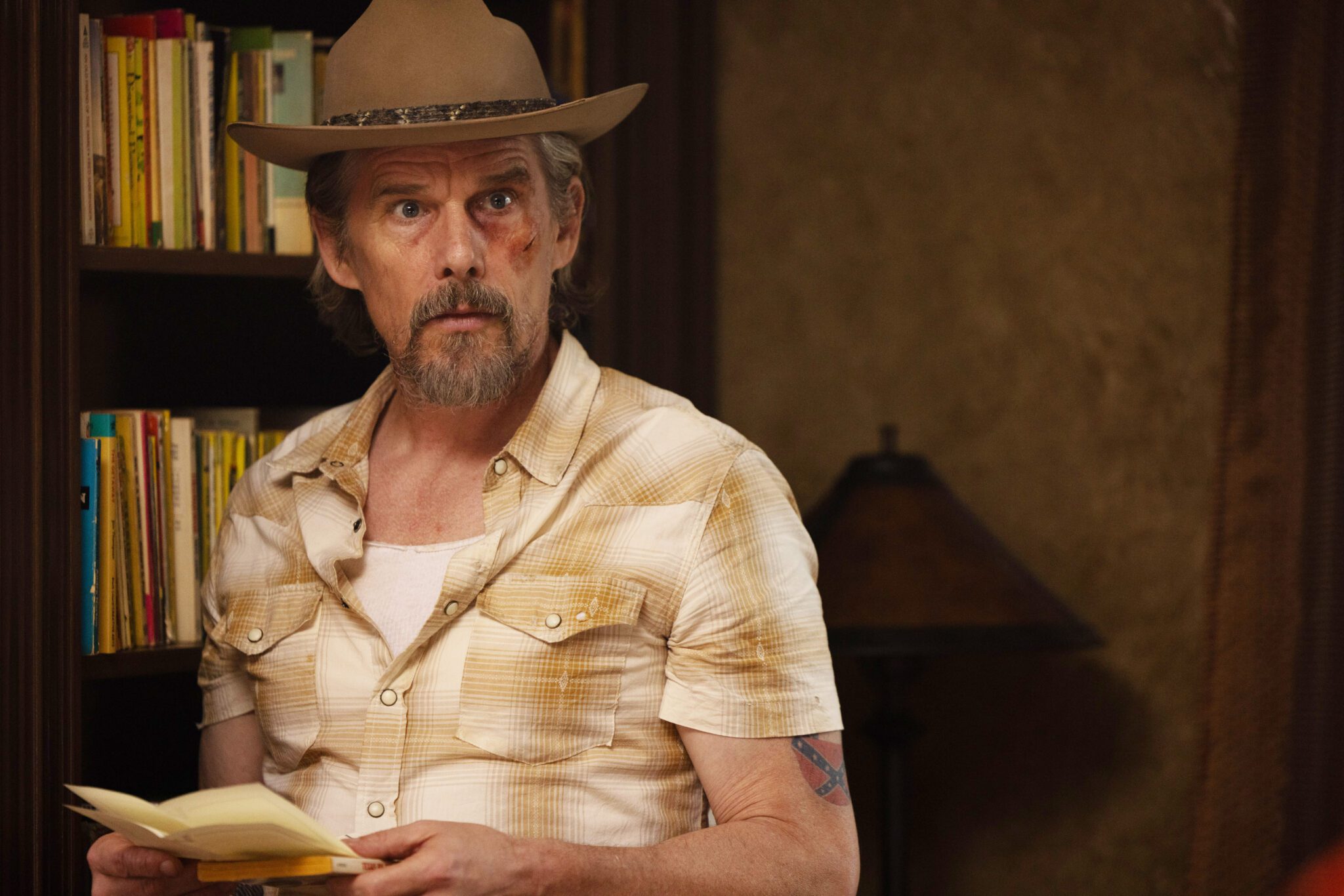
FX’s The Lowdown — “Pilot” Episode 1 — Pictured: (l-r) Michael Hitchcock as Ray, Ethan Hawke as Lee Raybon. CR: Shane Brown/FX
“This country is constant — the psychology of this country is really complicated and different to any other,” reflects Hawke. “And it’s rooted — you know, that was the first form that was ours, right? John Ford would say that the Western is ours, and the Western is full of lies, and the Western is epic and beautiful. It’s a complicated – but Lee is an American male, and he sees himself as a cowboy journalist, you know? And so, he’s going to embrace that. And that doesn’t scare me.”
“I like the maverick artist,” he continues. “My whole life, I’ve been drawn to that. And I like the maverick filmmaker. I mean, the Western is a part of how we were told stories as kids. So, we’re building off the generation before us, and we’re hoping to reinvent it and make it real in present tense now. But the baggage we carry is the baggage of the Western.”
But it’s Hawke’s gritty affability that makes Raybon so fascinating to watch. You see, in The Lowdown, Lee Raybon is more than a reporter. He considers himself a ‘truth-storian’. For Hawke, it’s this aspect of his character that really appealed to him most, especially since truth has become something that seems to be in short supply.

“Something that we didn’t foresee has happened with the internet of what it’s done to journalism,” Hawke begins. “And this idea’s very noble idea of giving everyone a voice on the internet, which seemed kind of wonderful and it was going to be free education and it was going to be equal opportunity, [but it] had this destructive force that we didn’t anticipate, which is the Tower of Babel, which is all voices all the time and corresponding chaos that that creates…”
“There was a time when being a journalist was really seen as honorable and an important safeguard to our society and they took it seriously… And right now, it’s very difficult for people in power and people not in power to understand how the truth is being manipulated for all of us in that, when big money is at stake, people don’t really like the truth to be told, even though it actually is in our best interest and who we can rely on. You know, a lot of people are getting their news from people that are not journalists, you know? And they’re getting their news from gossip. And that’s been hard throughout the history of mankind.”
And its this same passion for truth that drives Hawke and Harjo. Asked if they truly believe that journalists (and screenwriters, for that matter) have the power to change the world, the two men unabashedly agree that art provides important conversations that consistently challenge the status quo.

FX’s The Lowdown — “The Devil’s Mama” Episode 2 — Pictured: (l-r) Kyle MacLachlan as Donald Washberg, Ethan Hawke as Lee Raybon. CR: Shane Brown/FX
“I know they do,” Hawke adamantly affirms. “I mean, one of the things that I could point to really quickly is there’s a reason why authoritarian governments whenever they want to assert their power try to dominate the arts. It’s a way to shut down the conversation. It happens throughout history. It’s a go-to move. And I’ve always believed that the artistic community and the intellectual community represents the mental health of a society… So, I just know it’s powerful. I’ve seen it in my own lifetime. In a small way, I feel art has been hugely responsible for the decrease in homophobia throughout my life.”
“Yeah, and I mean, I’m a native filmmaker, like we’ve been here for a really long time, native people. I’ve been doing this for 20-something years now,” Harjo reflects. “And there was a lot of periods there were it felt like our voices were never going to be heard. There were serious conversations happening about how do we break through, like how do we do this, you know? There’s no way, they don’t care. I mean, I was in Hollywood meetings where native movies don’t sell, we can’t fund your film, you know? And it felt very dark. But Reservation Dogs was made, you know? It happens. And it happens over and over and over. And there are dark periods and yes, journalism’s a very tough place to be right now, but it is going to come out of that and it’s going to help lead us, and art too, will help keep leading us forward because they have to. Like that’s what they’re there for.”
The first two episodes of Lowdown are streaming on Disney+ now with new episodes on FX every Tuesday (and Disney+ the following day).
Photos courtesy of FX