Dead Man’s Wire proves that Gus Van Sant knows how to build a killer thriller.
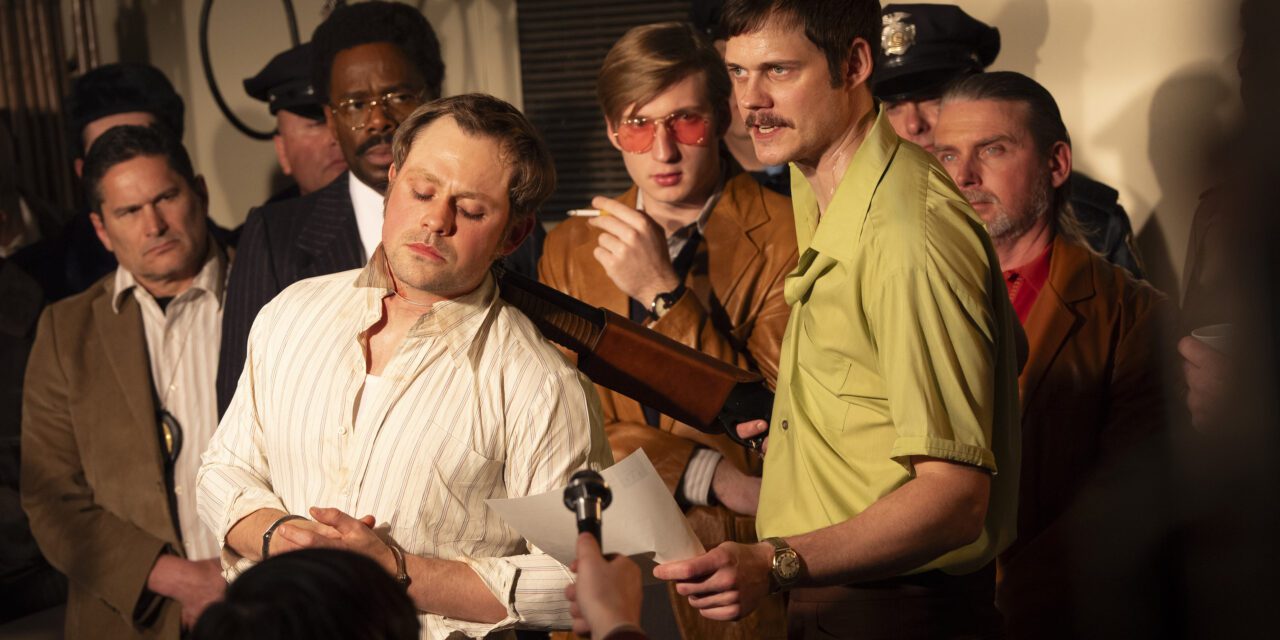
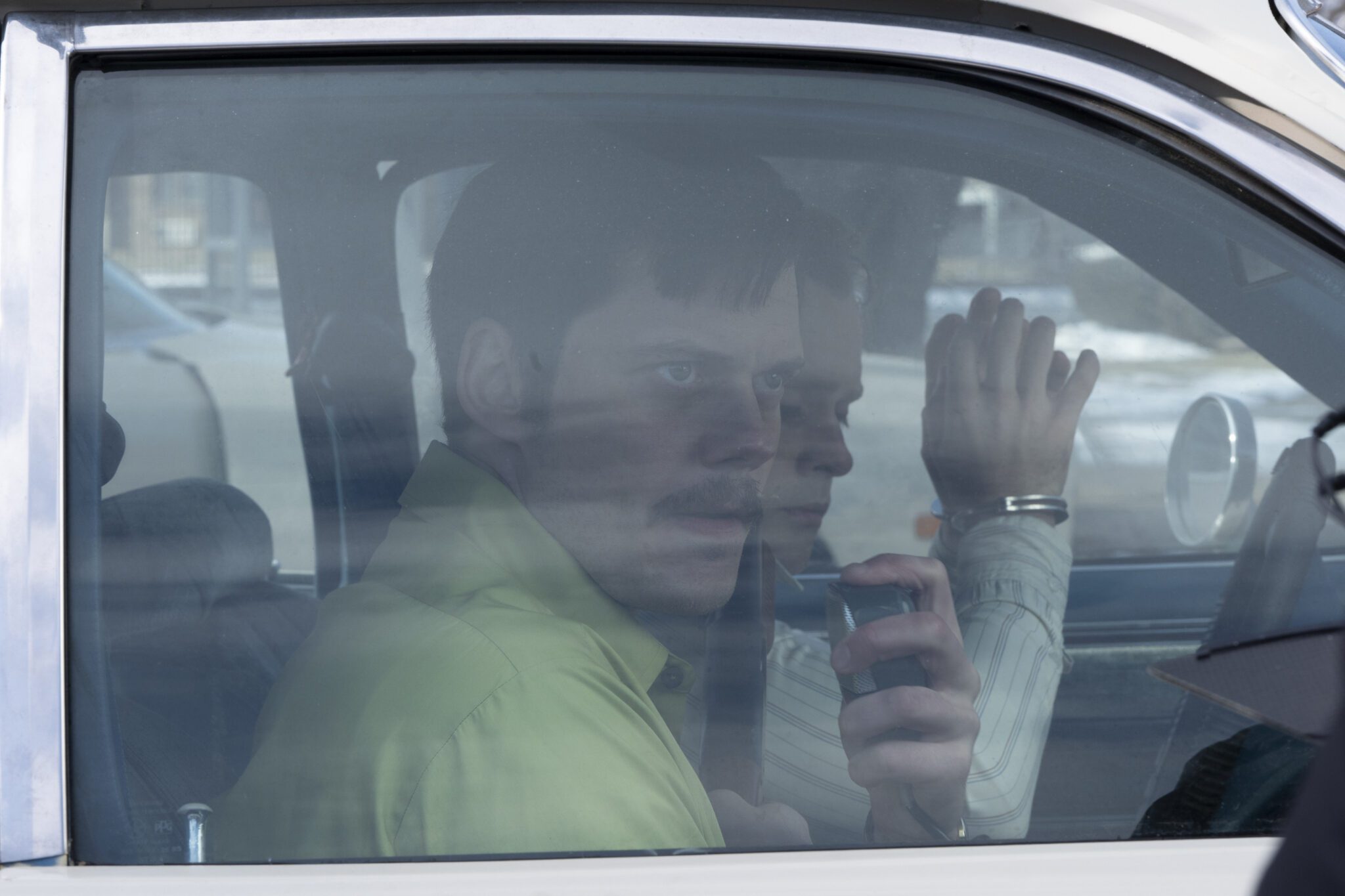
Beginning on February 8th, 1977, Dead Man’s Wire is the amazing true story of Tony Kiritsis (Bill Skarsgård), who decides to walk into the Indianapolis offices of Meridian Mortgages with more on his mind than money. Claiming to have a meeting with the company owner M.L. Hall (Al Pacino), he is armed and ready to seek justice for what he believes to be the corrupt actions of their corporation. However, after he discovers that M.L. has left for a luxurious Florida vacation, Kiritsis instead take’s M.L.’s son Richard (Dacre Montgomery) hostage instead, forcing him into a jerry-rigged device that involves a wire and sawed-off shotgun. Demanding reparations, Kiritsis and Hall begin an epic 63-hour standoff that becomes a media frenzy, causing tension between the police and public opinion regarding Tony’s actions.
In Dead Man’s Wire, Van Sant delivers his most compelling film in over a decade. Gripping and charismatic, this is a story that pulsates with fury from start to finish. Part Dog Day Afternoon, part Network, the film is infused with intensity yet still carries itself with a certain moral integrity.
Dead Man’s Wire. Photo Credit Stefania Rosini/Row K Entertainment
Visually, the film steps into the 70s with sepia-infused flair. Including blurred cinematography, newspaper clippings and recreated photographs, Van Sant immerses the viewer in the past. We are meant to feel like this is a bygone era. (Which, to be fair, it very much is at this point.) Yet, through his ‘David v. Goliath’ storytelling, Van Sant also ensures that the film still pounds with a heartbeat of relevancy.
Of course, credit must also be given to a manic performance by Skarsgård. As Kiritsis, the star finds himself yet another face of darkness to immerse himself within. While his character here may not be malevolent in the same way as Pennywise or Nosferatu, Skarsgård embraces the madness of Kiritsis with furious intensity. He’s erratic yet methodical; unpredictable yet entirely poised. Every move that he makes feels intentional but not entirely rational.
And yet, Kiritsis isn’t merely an obsessive madman either.

Dead Man’s Wire. Photo Credit Stefania Rosini/Row K Entertainment
Instead, as the film wears on, he becomes increasingly endearing. While he may be taking his revenge on the mortgage company that ruined his life, the film paints him with a graceful brush. Throughout his career, Van Sant has shown his ability to find the empathetic aspects of complex characters and that skill is fully on display in Wire. Though he serves as the film’s antagonist, Kiritsis is never portrayed as entirely the villain. There’s a compassion within Van Sant’s storytelling that allows Kiritsis to snarl with rage but still remain sympathetic.
While he doesn’t have the benevolence of Robin Hood but, strangely, Kiritsis almost feels as justified in his actions.
After all, Van Sant never allows us to forget the damage that has been done to Kiritsis’ life the Meridian Mortgage. And, while that doesn’t excuse his behavior, it does allow us to feel like he’s the victim (which, frankly, is difficult to do under the circumstances). Public support rises and people come to his defense, all while he holds a man hostage in his apartment. Is he a hero? No, not really. After all, Kiritsis is really in this to exact his revenge. But, at the same time, he never entirely feels like the villain either.
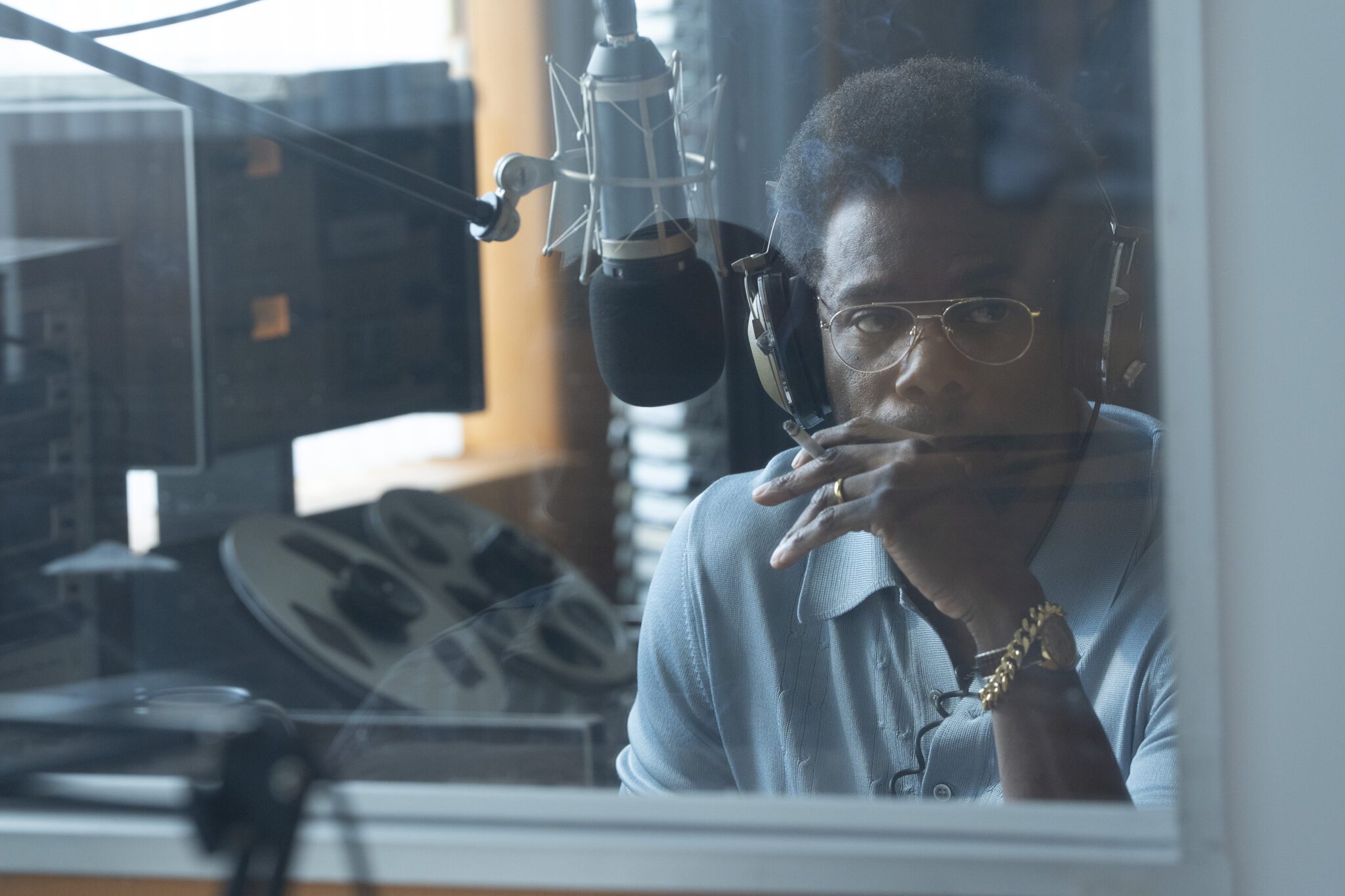
Dead Man’s Wire. Photo Credit Stefania Rosini/Row K Entertainment
But this change in public opinion is also reshaped by the involvement of Colman Domingo’s delightful ‘man of the people’, Fred Temple. Though a radio personality, his role in the events that follow elevate Fred into a major character. For Kiritsis, the radio personality becomes the only man that he really trusts. It’s not that he’s actively involved in the events but, somehow, he helps shape the narrative. By helping Kiritsis gets his version of the truth to the masses, Fred lets the people see him as more than a maniac. There’s a trust leveled upon Fred as a media personality that is almost surprising—and he takes that responsibility very seriously as well.
In this way, with its emphasis on the ‘little guy’ standing up to major companies, there’s simply something about the film that feels current and, more importantly, urgent. Yes, it’s a fun, noteworthy thriller set in the 1970s but it also speaks to the growing anxiety of the present day. There’s an immediacy to a film like this that taps into the increasing gap between rich and poor and the angst that has set in amongst people in the West. Dead Man’s Wire is a (literal) powder keg that’s fueled by socio-cultural intrigue. And that, unironically, feels entirely relevant.
Photos courtesy of Mongrel Media.
Dead Man’s Wire is available in theatres on Friday, January 16th, 2026.