
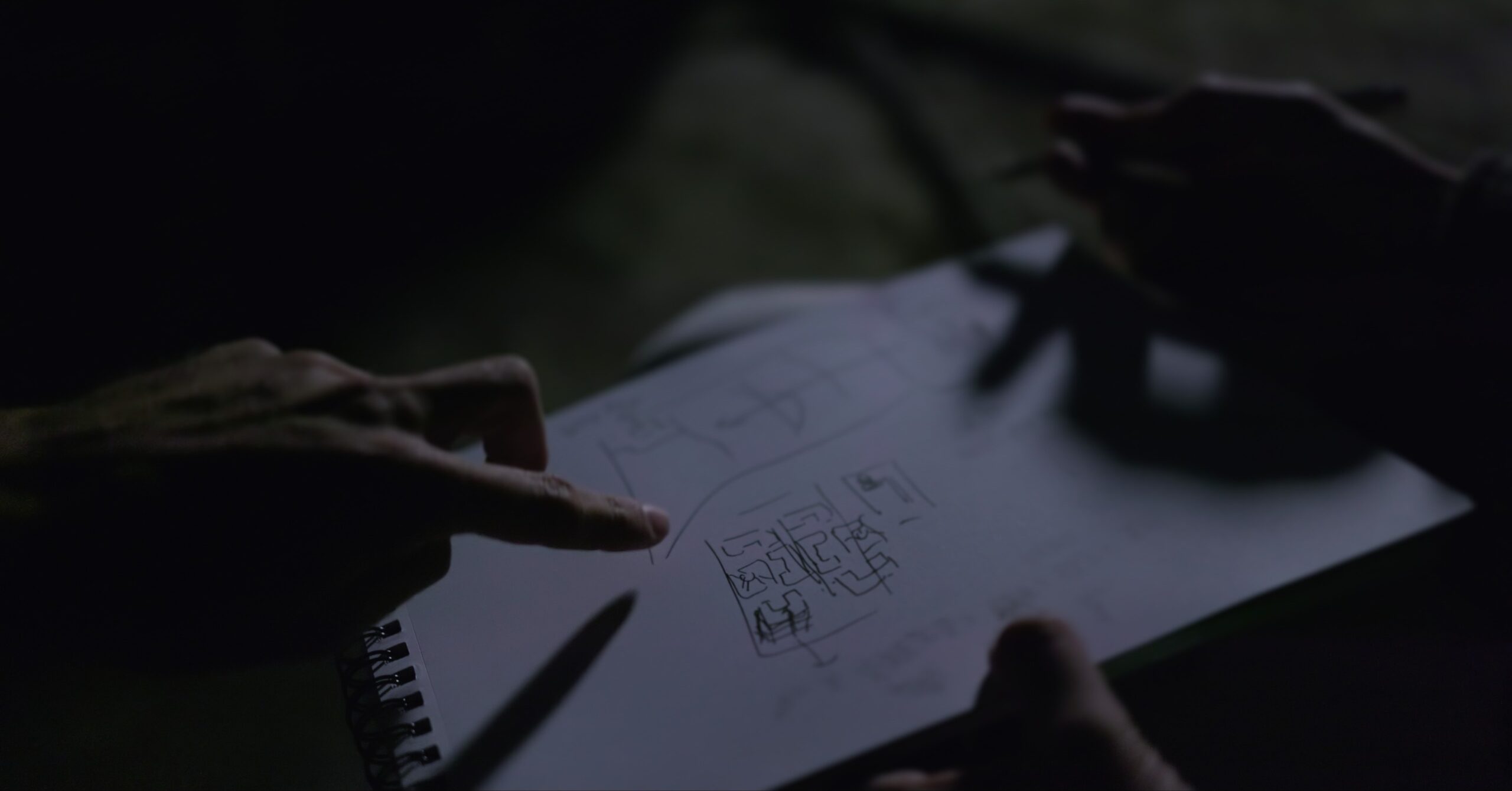
NAZA is a documentary film that presents interviews with members of the Israeli military and intelligence services whose jobs involved helping select targets for bombing, missile strikes, and assassination. On the rooftops of Tel Aviv, these people come to the filmmakers in the night and, whether motivated by guilt, hubris, or simply a need to get their memories straight, recall their involvement in the killing of Palestinian civilians in Gaza. The systematic, remote killing is illustrated through simple drawings and the recollections of these people, who, through anonymous interviews, bring to the world the story of how Israel justifies killing, employs humans to carry it out, and then executes it.
This is a film that is almost impossible to review because it really just needs to be witnessed. As an emotional experience, it plays unbelievably cold, with the filmmaking and editing methodical and to the point. It’s a style that fits well with the interviewees, who are equally direct about the nature of their work.
The film attempts a similarly quick, precise view of Tel Aviv and its citizens, capturing the stillness of this modern city that stands in stark contrast to what we imagine as we hear descriptions of what the bombing is like in Gaza. As we hear how technology is used to peer into and spy on the lives of Palestinians, the filmmakers give us their own gaze into the lives of Tel Aviv citizens. They go around doing normal things, walking in slides, lying on their furniture, watching the news, and this is the only glimpse we get of them.
We learn how Palestinians are placed on what feels like a giant chessboard for Israeli officers, informed by computer algorithms and AI-assisted targeting systems used to determine which people, or more precisely which phones, are connected to people believed to be connected to Hamas. The film presents this as a deeply imprecise system, one that lacks care for the human beings living in Gaza and allows the operation to resemble a video game. The people operating these systems justify their violent actions because they see them as part of defeating a legitimate enemy. They are determined to protect their homeland from a group that has been demonized, dehumanized, and presented as a threat to everything they should care about.
It’s a job for them. Only after they leave these jobs do some of these officers express remorse or see, in retrospect, the inhumanity of their work. Even then, we see how psychologically they continue to justify themselves. It’s a very difficult film to sit with, as we see what people are willing to do for a job, for a place in society that brings them respect, makes them the envy of their neighbours, and seems to support the national cause.
If wars in the past have taught people how brutal and devastating violence is, this film reminds us how technology has enabled those with power to distance themselves from the process. The film also reckons with the question of how an ethnic group victimized by a genocide like the Holocaust could fail to recognize parallels in the suffering their nation is inflicting on another people. It suggests that time and distance can create the ignorance needed. You don’t even need to witness it. If it gets too real, you can always turn it off.
Yet the effects of war remain with the living. We see that some of these officers are psychologically scarred and have perhaps only started to confront how tormenting their own actions have become for them. It’s easy to see why.
For all the survivors in Palestine, one can only hope they find the strength to persevere in the wake of grief, forced displacement, and torment in the midst of genocide. But, as the film notes, it continues. Perhaps a new Israeli government will try to force some humanity into the way it deals with Palestine. One can only pray for that. You can pray for these souls. You pray that a computer screen won’t stop them from seeing the humanity of the people they are dealing with.
But history has long noted that human beings are remarkably capable of separating what’s right in front of us from reality.
NAZA is available in theatres now.