

Black Phone 2 swaps its protagonist as it explores the dreams and abilities of Gwen (Madeline McGraw), sister of Finney (Mason Thames) who is still trying to figure out how to resume his life after his time with The Grabber (Ethan Hawke). Although the siblings know he is dead, the Grabber’s phone starts ringing once again and Gwen’s dream calls her to a place where he may still have the ability to hurt people. Now, along with Gwen’s new friend Ernesto, the siblings head out to Alpine Lake Bible Camp to confront a tragedy that occurred decades ago and may be tied to them in ways that they would never expect.
Phone‘s main strength is in its set pieces, which both impress and feel under-utilized. The main sequence becomes the camp, a bleak, wooden group of buildings that back onto a frozen lake. These become the locations where the main confrontation between the Grabber and Gwen take place, even though he is only present in her dreams. As the two must confront each other, the film creatively overlaps dreams and reality, using a Super 8 film camera to differentiate between them. The dreamlike atmosphere juxtaposes with the nightmare images Gwen witnesses and the dramatic jump cuts where the Grabber seems to be ready to take her at any point. Here, the Grabber begins to be able to hurt Gwen in her dreams, putting Finney and Gwen in a desperate plight to understand how he has returned from the dead.
The film is at its best when it ratchets up the tension and chaos of what is happening onscreen. The most memorable scenes see The Grabber causing chaos for Gwen in her dreams, creating horrifying results in the real world. The moving camera is not afraid to break some rules of conventional cinema and, in doing so, helps convey an urgency and surprising atmosphere where a jump scare is only the warm up for the real horror. The music certainly helps with this feeling as it uses electronic bass beats to give Phone‘s most intense scenes a quickened pulse that booms over the supernatural threats that Gwen and Finney face. These kind of scenes are quite present in their time at Alpine Lake and do have a certain amount of rewarding pay offs for what was set up before (but admittedly, did feel a bit too slow).
The family drama is a second thematic through-line for the film that does not really pay-off as well. While taking a mostly logical backseat as the sidekick to Gwen’s journey, Finney as a main character barely gets any development. It does feel like they bank on their established audience to enjoy who he became as a character in the first film because this sequel offers very little in terms of character growth.
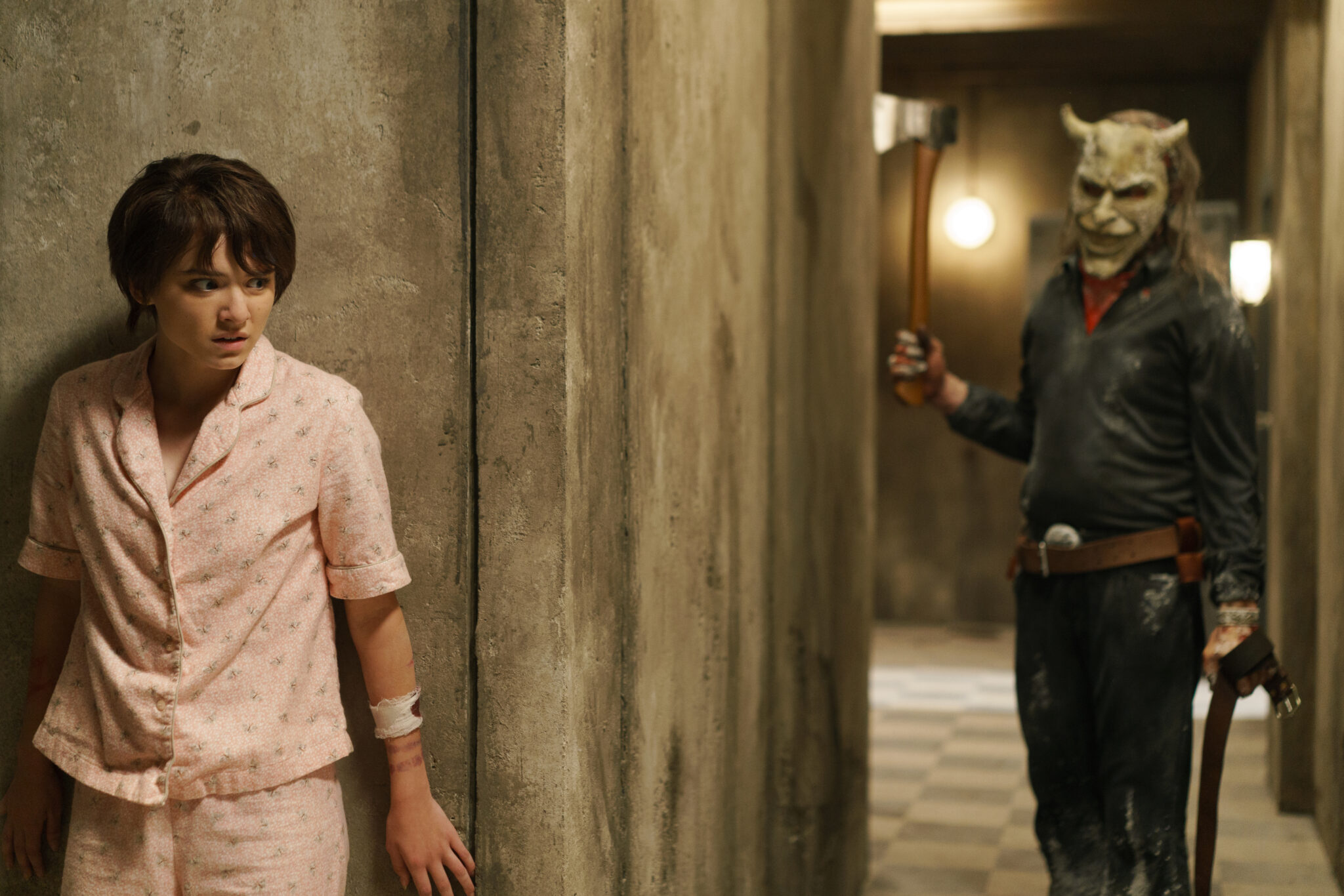
(from left) Gwen (Madeleine McGraw) and The Grabber (Ethan Hawke) in Black Phone 2, directed by Scott Derrickson.
Furthermore, Gwen’s journey, while the focus, also does not really have ,an arc that is interesting for this kind of character. Mostly, she is forced to become more of a leader, since she is the one facing the conflict and becomes a more complete and confident person. However, most of that growth seems very much thrust upon her in the life and death situations she faces. Only her romance with Ernesto really grounds her character in any real world development. Her overall emotional connection to her family, which is a focus of many scenes, is not nearly as thoughtful and unfortunately, falls flat when trying to create emotional dialogue in key moments. In particular, the actor’s delivery sticks out in an negative way, distracting from the heart of the film’s emotional message. Though Phone mostly leaves their emotional connection behind, except for a couple of exceptional scenes where their awkward chemistry shines through. These are perhaps the funniest and most enjoyable scenes in moments that feel like the calm before the [horror] storm.
What Phone seems to offer is a contemplation on trauma and the effects of PTSD on those who the traumatized person leaves behind. For the victims of The Grabber, there is a question of whether or not they can ever rest and so, the film offers a piece of comfort for lost and troubled souls. Interestingly, the film also has a religious discussion about evil and how the afterlife may deal with our sins. While it is not a movie that is explicitly pro-Christian (though director Scott Derrickson has discussed a Christian past), it is a film that wants to offer a world where there is something on the other side and there is a chance for those who die to live in a beautiful place.
Derrickson has said in interviews that his faith is a complicated issue. Having gone from fundamentalism to secular philosophy courses in a matter of months was an intellectually challenging experience that makes him hesistant to identify as a Christian. But you can see some of that shared hope that most Christians have with the events in this movie. Even Gwen’s mom, who we know met a grisly end, is still out there in a beautiful place despite the violent circumstances that she and the Grabber’s victims faced. It is interesting to get a film that, while not solely focused and not even really provoking spiritual thought, is made by a man who is willing to confront and declare what he thinks the afterlife could be though fiction. For a group of characters who often feel like they are dealing with the Devil in The Grabber, it means a lot and it does make some sense that there is a place for those who face violence and trouble to look forward to after their death.
Black Phone 2 is available in theatres on Friday, October 17th, 2025.