
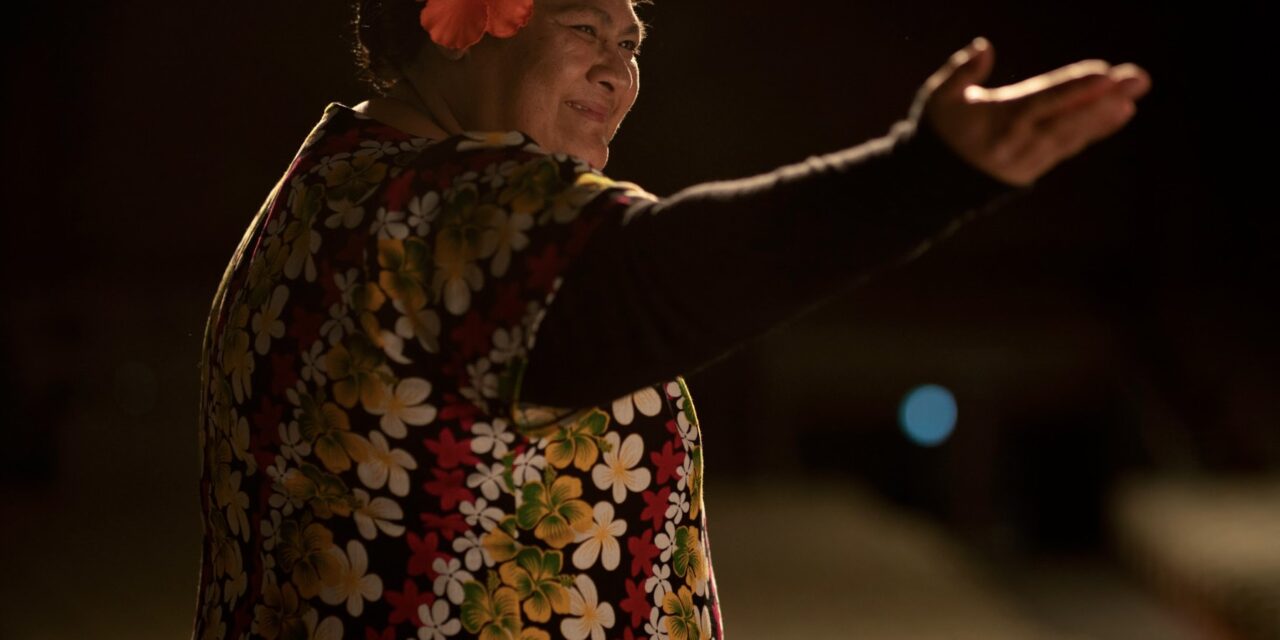
Teachers inspiring students is a familiar theme in films. Tinā, from writer/director Miki Magasiva, is the latest in a long line of such films. In this film, as in most such films, it is a two-way street as a teacher may not only bring something new to the students, but learn from them as well.
As the film opens, Mareta Percival (Anapela Polataivao) is teaching in a neighborhood school in New Zealand. Her daughter is stressing about an audition to a prestigious music program. But not long after talking to her on the phone a deadly earthquake hits Christchurch. When her daughter is one of the fatalities, Mareta withdraws from life.
Three years later, she is still effectively shut off from everyone and everything. When it is threatened that her benefits will be cut, she goes to a job interview at an elite private school. She really doesn’t want the job, and as a Samoan, she would be very different from everyone else at the nearly all white school. But she manages to impress the outgoing head of the school, even though the incoming head is outwardly rude and condescending toward her. On taking the job, she stubbornly declares, “I’ll do what is required of me.”
One day, she notices Sophie (Antonia Robinson) struggling while playing a piano. Mareta senses that Sophie is a wounded soul (she also has a scar on the back of her hand). After starting the teaching job, when Sophie is in trouble for not being accomplished enough with her music, Mareta tells the head she is going to start a choir.
The key for Mareta when it comes to choir is that it is a joint venture. It is not about individuals, but about the group. We get the idea that those who join the choir are all a bit wounded. Sophie is the key among these. (Later we’ll see the extent of her physical scarring, but we know that is just a visual that lets us know of her emotional scarring.)
This school thrives on excellence. The incoming administrator has the opinion that if the school can’t be the best at something, they shouldn’t do it. The idea of a choir runs counter to his concept of quality. Yet, Mareta persists and even sets a goal of entering the choir in a national competition, The Big Sing.
A subplot involves another student, who both sings and plays rugby. When he opts for choir over sports, it upsets the head and the boy’s father who chairs the school’s board. All of this puts Mareta in their crosshairs. She is creating a choir with no record of excellence, and costing the school a star player (and messing up his father’s plans for him).
Yet, for all her talk about how a choir is not about individuals, Mareta continues to live her life cut off from the world around her. A friend had tried to get her to teach at her former school, but Mareta is too busy grieving. But as she works with the students in the choir, she takes on a nurturing role. (“Tinā” is the Samoan word for “mother”.) It allows her to find some sense of meaning, even as she knows that all of life it temporary.
There are trappings of the spiritual along the way. We see Mareta in church (where she is not a frequent attender). She later takes the choir there for their first performance. Her favorite song is “Nearer My God to Thee.” Another hymn also plays a role. The school is St. Francis School. Yet it seems that all that is really just meaningless and irrelevant to the lives and the suffering of the characters.
Of course, at The Big Sing it doesn’t really matter if they win. The victory is that they are there and that they have grown. But it will be a bittersweet experience.
Tinā is in select theaters.