

No guts, no glory.
Directed by Justin Tipping, HIM tells the story of Cameron Cade (Tyriq Withers), a rising-star quarterback who’s touted to be the next big thing. Having worked his entire life to make it to the big leagues, Cameron is one night away from his dream—until he’s suddenly attacked by an unknown assailant before the big combine. But all is not lost. Even with his future in peril, Cameron receives an invite from his childhood hero, Isaiah White (Marlon Wayans) in a last chance training week on his private compound. As an eight-time champion, White bleeds success and the opportunity to revive his career is too much for the injured Cameron to pass up. However, as their training devolves, Cameron becomes increasingly uncomfortable with White’s road to greatness, forcing him to choose who he wants to be.
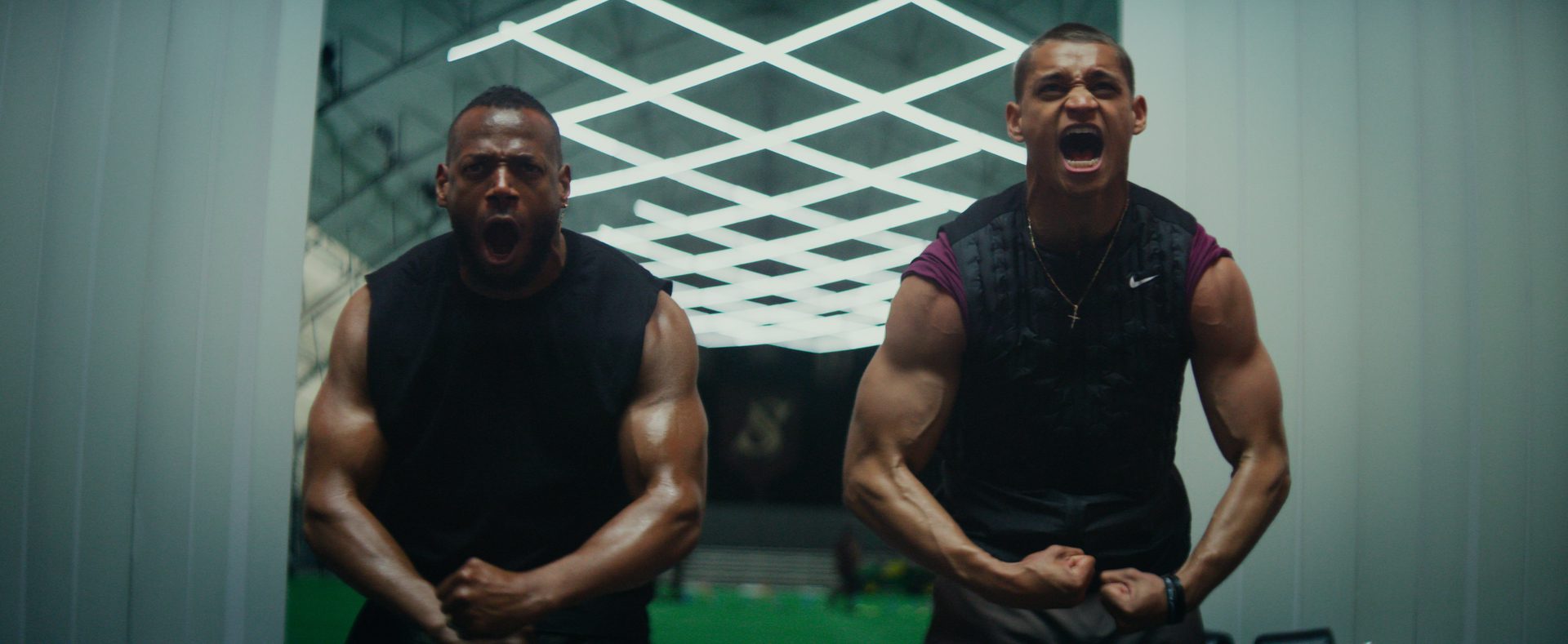
(from left) Isaiah White (Marlon Wayans) and Cameron Cade (Tyriq Withers) in HIM, directed by Justin Tipping.
There’s an intensity to HIM that is bleeds on screen. In every ‘chapter’, Tipping wants his film to feel like his characters are locked in a gladiatorial arena where the only way out is to be the last man standing. And the visuals are what HIM does best. In short, HIM is a fiery feast of visual violence. Every moment of training is meant to feel like an exhibition in human torture. Through its use of frenetic editing, severed limbs and endless blood splatters, the film delights in disorientation and destruction.
But, despite its wild visual sensibilities, the best part of HIM is a deliciously devious performance by Wayans. As Isaiah, Wayans fully taps into his dark side. Sprinting between modest and maniac, Wayans’ performance as the footballer at the tail end (tailgate?) of his career is consistently compelling. Erratic and emotional, Isaiah is part mentor and part monster and Wayans clearly relishes the opportunity to step into the role. Wavering between a man broken by fame and an athletic god determined to hold on to the spotlight, Wayans does a good job of knowing when to dial his performance up and down so that he never becomes a parody of himself. Here, Wayans’ comedic charm gives way to chaotic cruelty as he viciously beats Cam into submission.
After all, in Him, football greatness can only be achieved by stripping its athletes of their humanity.
Keeping a glimmer of honesty underneath its insanity, Tipping taps into the true brutality of competitive sports. In HIM, the world of football is the very heartbeat of the nation and Tipping never allows us to forget what’s at stake. The drive to succeed is always difficult but here, HIM wants us to understand the pressure put upon athletes is akin to creating soldier. The best feel nothing in the face of pain and pursue victory at the sake of personal commitments and compassion.
After all, they aren’t only representing themselves. Their sacrifices are met with the desire to represent the entire country. Filling the screen with blood reds, clean whites and icy blues, Tipping bathes his film in American colours that reinforce the national vibe of the film. But, more than simply national pride, he wants us to understand that the temptation to grab the golden ring of sports glory is a status unlike any other.
For Isaiah and Cameron, being the GOAT is equivalent to being God.
In many ways, it’s fascinating to hear the reverence that the film holds the pinnacle of sports achievements. Tipping floods the screen with religious imagery and dialogue that reinforces the power that can be attained at the top of the celebrity ladder. Crucifixes, communion and Scripture are all co-opted to emphasizes the spiritual power of stepping onto the gridiron. At one point, Tipping even uses Leonardo’s The Last Supper as a motif, with press taking on the role of the disciples. (In fact, the team in question are even called the Saviors.) While the film is far from subtle in its imagery, it does drive home the point that sports heroes are handed god-like authority in today’s culture.
But is it worth it? Tipping wants us to question whether or not the road to greatness is equal to the cost. Isaiah demands everything of his young protégé. He tempts him with excessive delights, asks him to denounce his family and, above all else, live only for the endzone. Dangling fame like a proverbial carrot, Isaiah’s methods seem intentionally designed to break Cameron physically and emotionally. He doesn’t just want to Cameron to prove his worth. He seems to want to steal the young man’s soul.
Now, having said this, that same Machiavellian madness that makes the film unique is also what keeps the film from true greatness. With so much emphasis on sensory overload, there are moments that the script for HIM goes for the endzone when it should probably slow down and take a knee. (For example, while the story’s structure of ‘mentor gone wrong’ may be reminiscent of 2014’s menacing Whiplash, HIM’s penchant for visual madness prevents the film from achieving the same level of intensity.) In essence, there are moments when the chaos elevates HIM. But there are also others where it does the opposite.
As such, while it doesn’t quite end up being a blow-out victory, HIM remains a winner. Despite the overwhelming visuals, Tipping has a clear vision that he executes effectively. HIM is wild, unruly and downright nasty. But it just doesn’t always score.
Him is available in theatres on Friday, September 19th, 2025.