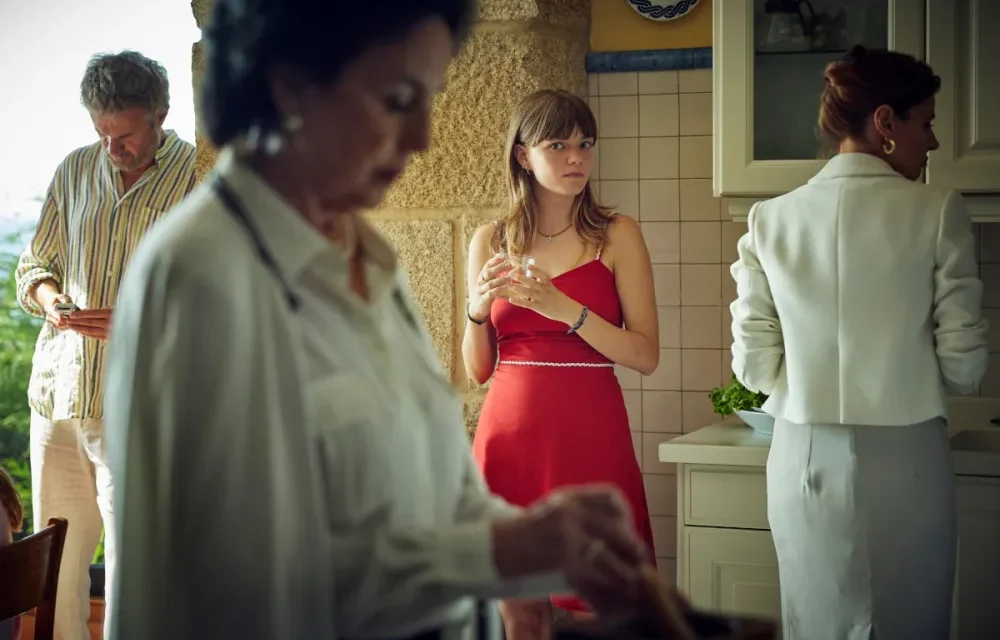
In a film that views memory and personal investigation in ways reminiscent of autobiographical works like Aftersun and the excellent Canadian film, Blue Heron, Romeria collides with a darker version of Bergman’s Summer Interlude. Like the former two films, this one uses an arthouse/realist style to tell its story. Marina (Llucia Garcia), who grew up without her parents, is forced to seek out her late father’s family—whom she has never met—in order to prove her ancestry for college grants. Her journey, meeting her father’s siblings and their families, leads to the discovery of secrets, family shame, and a complicated history of love threatened by distance, disease, and desire.
I compare the film to Aftersun and Blue Heron specifically because the director acknowledges that the film is about a version of themselves. Marina, who is a prospective cinema student, films her journey along the coast to meet her family. The film then presents Marina’s footage alongside a voiceover of her mother reading from writings that describe her time with Marina’s father, Alfonso. In doing so, the film openly embraces its meta aspect.
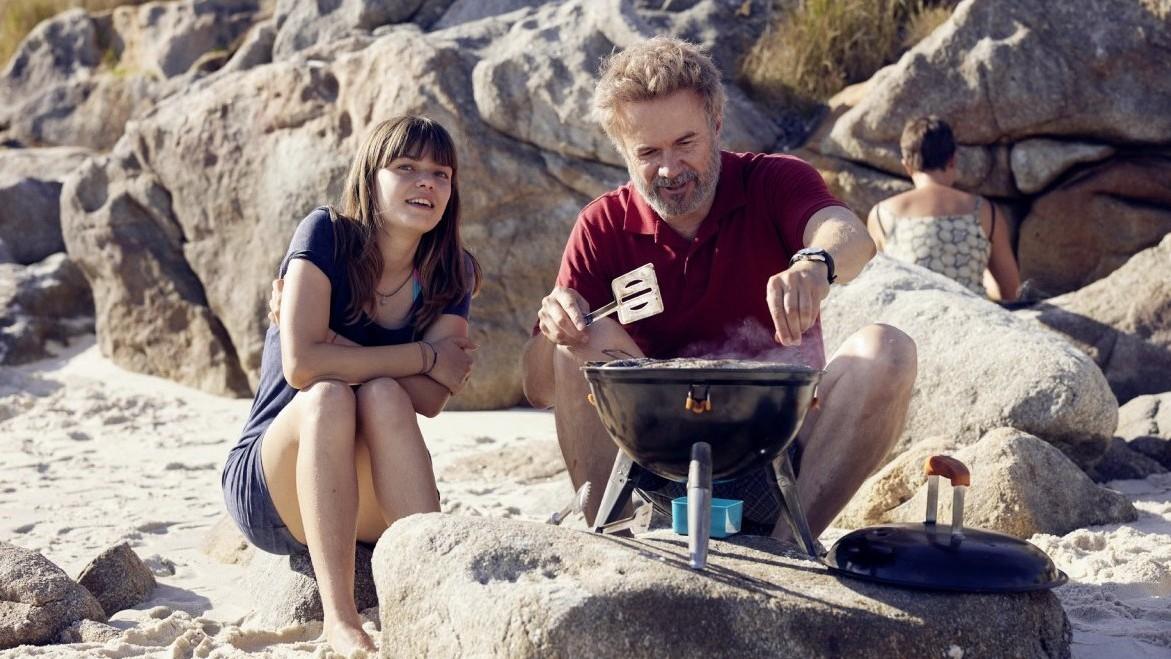
Every scene is painted with a sincere melancholy. An early scene, where Marina watches a mother and daughter argue about a wedding dress, is layered with quiet sadness. We see how Marina holds herself back from emotional vulnerability; she is not used to family and certainly does not expect these people, who were only days ago strangers, to become her family. Yet she shows a strong desire for that connection. More importantly, as a coming-of-age story, she wants acceptance and confidence, and slowly discovers she will need to find that within herself rather than relying on others to give it to her if she is to thrive in her life and career. Her actions become the most important part of the film, marking key emotional turning points. This becomes especially clear in the second half, where she remains more passive, listening to her family’s accounts of her father, before eventually choosing to act on that information in moments that define her growth.
The film does an excellent job using props, small moments, and striking tableaux to communicate both beauty and heartbreak. The landscapes of the Spanish coast are themselves stunning, bathed in natural light and neutral colors that give the film its muted, melancholic tone. Cinematographer Hélène Louvart, known for her work on films such as Never Rarely Sometimes Always and 2023’s La Chimera, continues here with luminous frames and a strong sense of immersion in the coastal waves—you can almost feel and smell the salt air. The supporting performances are also wonderfully naturalistic, drawing us fully into the situation. No exaggerated acting flourishes stand out, which helps the film feel grounded and authentic.
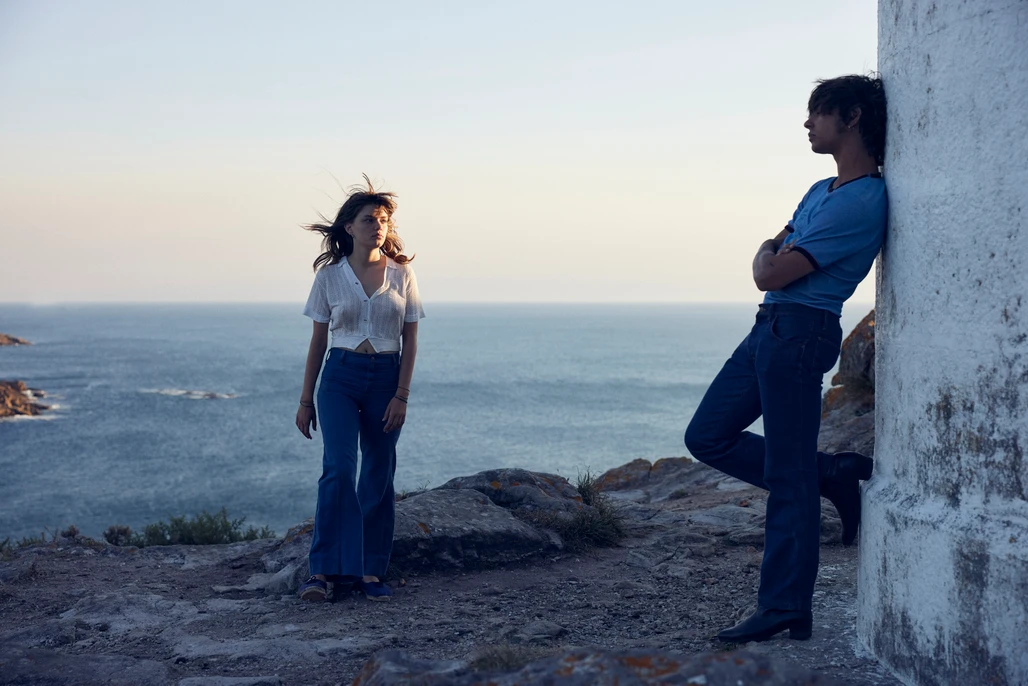
The film thoughtfully acknowledges the disconnections that can occur within families, especially when parents disapprove of partners or lifestyles, whether for legitimate or more elitist reasons. It is a sobering and subtle work in the European tradition, one in which Marina discovers her parents through the eyes and memories of others—a strange and sometimes surreal experience. The film visualizes this through flashback sequences that attempt to capture the love, spontaneity, and hardship that shaped Marina’s parents’ lives and the circumstances surrounding their deaths, as well as those of others in their generation who faced similar struggles.
Ultimately, it is a personal meditation on memory and its power. The absence of memory is equally potent, affecting Marina and her father’s family as it becomes clear that some chose to forget or actively suppress aspects of her father’s life in his final years. The film does not aim to deliver a single, fixed message, but instead hopes the audience connects with Marina’s emotional journey. Its melancholic tone will likely resonate with anyone who has experienced complicated family histories or relationships fractured by distance, difference, or conflicting desires. It is a quietly beautiful film that leaves a strong impression, and it deepens interest in the work of director Carla Simón. A Cannes-inflected, deeply personal piece that captures both the feeling of summer and the emotional weight of reconnecting with family, old and new.
Romeria is available in theatres on Friday, July 3rd, 2026.