“We are living through a rapid phase of transition, a ‘change of era,’ in which—while some are vying for the future of new technologies and others dedicate themselves to reflecting on the matter—most people are watching and waiting, observing from afar and merely hoping for the best. For this very reason, crucial questions impose themselves on our conscience and can no longer be avoided: Where are we going? Toward what goal do we wish to orient ourselves” What direction should we choose as a people and as a community?” [Magnifica Humanitas, §6]
I was eagerly anticipating Pope Leo XIV’s Encyclical Letter focused on Artificial Intelligence. I find the subject interesting. I know that many see AI as a looming threat, while others see it as a great hope for advancement.
I must let it be known that I play around with AI. I ask Claude and ChatGPT silly or serious questions. I sometime ask them the same thing to compare their responses. I have an AI coach on my fitness app. And, of course, we all rely on AI when we use our favorite search engine, and bemoan the AI that places ads in our social media feeds.
Of course, AI entails much more than these uses. It is increasingly used in financial markets, by the military, and in business. In the entertainment industry, the use of AI has been a key issue in negotiating contracts—should AI write a movie or TV show based on what “works”, or can AI be used to look and sound like a particular actor?
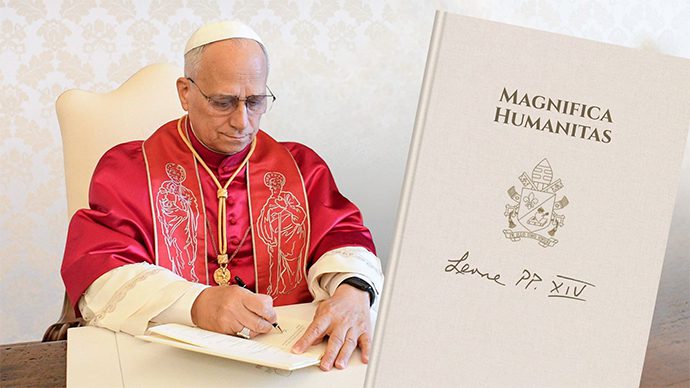
Magnifica Humanitas is a document that encourages us to consider the spiritual and moral questions that surround the growing presence of AI. It is not a denunciation of AI, but it does understand that there can be dangers that accompany the rapidly expanding uses of AI in our world.
The Encyclical is addressed “to all the Catholic faithful, to all Christians and to all men and women of goodwill.” [§16] (John XXIII was the first to use such a universal address in Pacem in Terris, and others have followed.) This is a topic that needs to be considered not just by the Church, but by all peoples, because we are all affected by what is happening.
The Pope begins, not with AI itself, but rather with a metaphor using two Biblical images: The building of the Tower of Babel [§7] and the rebuilding of the walls of Jerusalem by Nehemiah [§8]. The first was an amazing project, but it was conceived out of pride and self-sufficiency, without reference to God. Nehemiah’s project was a work of cooperation involving many groups who came together. That metaphor will return from time to time as Leo considers the issues involved in AI in our world.
Because Leo wants to set this issue within the Chruch’s historical teaching, he gives an overview of the Social Doctrine of the Church, beginning with Leo XIII in the 19th Century and the way popes have continued to bring new perspectives to the doctrine through the years that have followed.
The Social Doctrine of the Church “is not a handbook of principles or norms to be applied, but a process of shared discernment. It is born from the encounter between the eternal truth of the Gospel and the questions of history. It allows itself to be challenged by the signs of the times, and draws nourishment from the contributions of science, culture and human experience.” [§27]
The key tenet of the Social Doctrine that is focused on as the Pope considers the questions surrounding AI is “the inherent dignity of the human person.” To discuss that “we must … reflect on the common good, the universal destination of goods, subsidiarity, solidarity and social justice.” [§46]
Magnifica Humanitas always has at its center the concept of the human person. The subtitle for the Encyclical is “On Safeguarding the Human Person in the Time of Artificial Intelligence.” The key understanding of personhood is “At the heart of the Christian understanding of the human person lies the great biblical affirmation that men and women are created in the image and likeness (cf. Gen 1:26-27) of the Triune God. Created for relationship, every human person is planned and willed by God to enter into communion with him, with others and with creation. Human dignity does not depend on a person’s abilities, wealth or position in life, nor on the right or wrong choices made; instead, it is a gift that precedes and transcends each person, endowed by God as an expression of his unfailing love. For this reason, the human person always remains the ‘way for the church’ and the heart of every authentic path of integral human development.” [§50]
In all the discussion that follows, this idea of human dignity and value is the litmus test by which AI developments are judged. That leads to consideration of the way technology is controlled by a handful of people and the power that gives them—even surpassing the power of nations. It also sees ways that the environmental impact of AI infrastructure affects the world and society. Issues of new forms of slavery and war come under scrutiny. (Note that Leo offers an apology for the ways that the church condoned the abhorrent practice of slavery for centuries [§176], and also reaffirms “that ‘just war’ theory … is outdated.” [§192]
The Encyclical also reaffirms the concept going back to Leo XIII that profits and efficiency are not of more importance than the human person. That idea has several applications of the consideration of AI in our lives.
Magnifica Humanitas should not be taken as a Luddite manifesto. It certainly sees the potential value of AI. It also sees that it creates not just legal or moral issues (as important as those are), but a deeply spiritual dimension that also needs to be addressed as AI develops.
The goal of all this is to urge its readers (including “all men and women of goodwill”) to not be among those who “are watching and waiting, observing from afar and merely hoping for the best.” Instead, “Let us not be afraid to get our hands dirty on the ‘construction site’ of our time.” [§16] He references again Nehemiah: “I see in him a striking parable of our own vocation, which is not to be passive spectators of social and cultural fractures, nor mere commentators on what is crumbling, but men and women prepared to enter the construction sites of history—research laboratories, technology companies, schools, the media, institutions and local communities—in order to rebuild what has collapsed and protect what is threatened.” [§241]
To take on such a large and imposing task may seem to many to be too much. But Leo believes that directing the way the world will change is not only possible but imperative. “The memory of the saints, righteous people and the oft-forgotten peacemakers, show us that grace does not magically eliminate conflict, but instead it inspires active resistance to evil and an astonishing creativity in doing good…. For this reason, even when suffering seems to have the last word, Christians serve the good and are sustained by a theological hope that gives reality both meaning and direction.”[§211]
He goes on to quote The Lord of the Rings, “’It is not our part to master all the tides of the world, but to do what is in us for the succour of those years wherein we are set, uprooting the evil in the fields that we know, so that those who live after may have a clean earth to till.’ The civilization of love will not arise from a single or spectacular gesture, but from the sum total of small and steadfast acts of fidelity that serve as a bulwark against dehumanization.” [§213]
Magnifica Humanitas, then, is a call for involvement. I know that this is a lot to consider and chew on. It is easy to look at the world we see—in which billionaires fight over the biggest AI (and rockets) with little regard for anything but power and profit; in which technology reaches into our homes and society in ways that are not always centered on the common good; in which war becomes more mechanized and “collateral damage” is considered merely data—and think that the battle is already lost—that Leo XIV is too late. But keep in mind that this is just the latest examination of the Social Doctrine that began with Leo XIII. This Encyclical invites us to be a formative part of the future. Because if we are not working for the common good in our own family and communities, we are leaving that future to those who would build a new Tower of Babel.