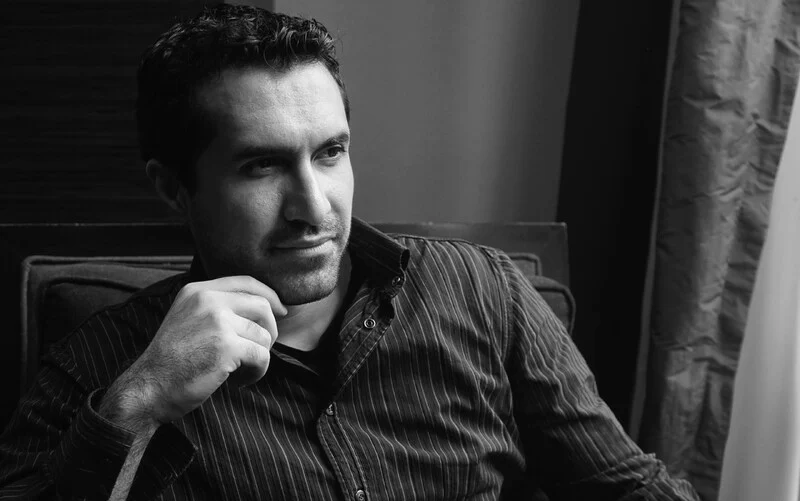
There is a silence that hangs over La Palma, an island whose 2021 volcanic eruption left behind not just destruction, but a strange and trembling beauty. The lava fields stretch like black oceans over what were once homes, cafés, and schoolyards. When writer-director Shervin Kermani first stepped onto that landscape during a 10-day film accelerator led by Werner Herzog, he found himself drawn not to the spectacle of catastrophe but to the echoes of what was no longer there. And, in that stillness, a story began to whisper to him.
“I kept thinking, how do you approach this indirectly?” he recalls. “When you’re writing poetry, you don’t go through the front door, you break in through a window.”
It was in that window, cracked open by the island’s lingering ghosts, that Ramón Who Speaks to Ghosts was born.
The short film, a docu-fiction in appearance, dreamscape in spirit, follows Ramón, a gentle, eccentric sound recordist who roams the post-eruption landscape listening for ghosts. His gear looks makeshift, even comical: antennae, wires, a microphone pointed into the wind like a divining rod. But beneath the film’s playful surface lies something more piercing. Locals on the island told Kermani not just about the homes they lost, but about the tiny rituals that vanished with them. The clink of ceramic mugs at a morning café. The hum of conversations overlapping. The specific soundscape of a life. It struck him: what people mourn most is rarely the monumental, but the mundane.
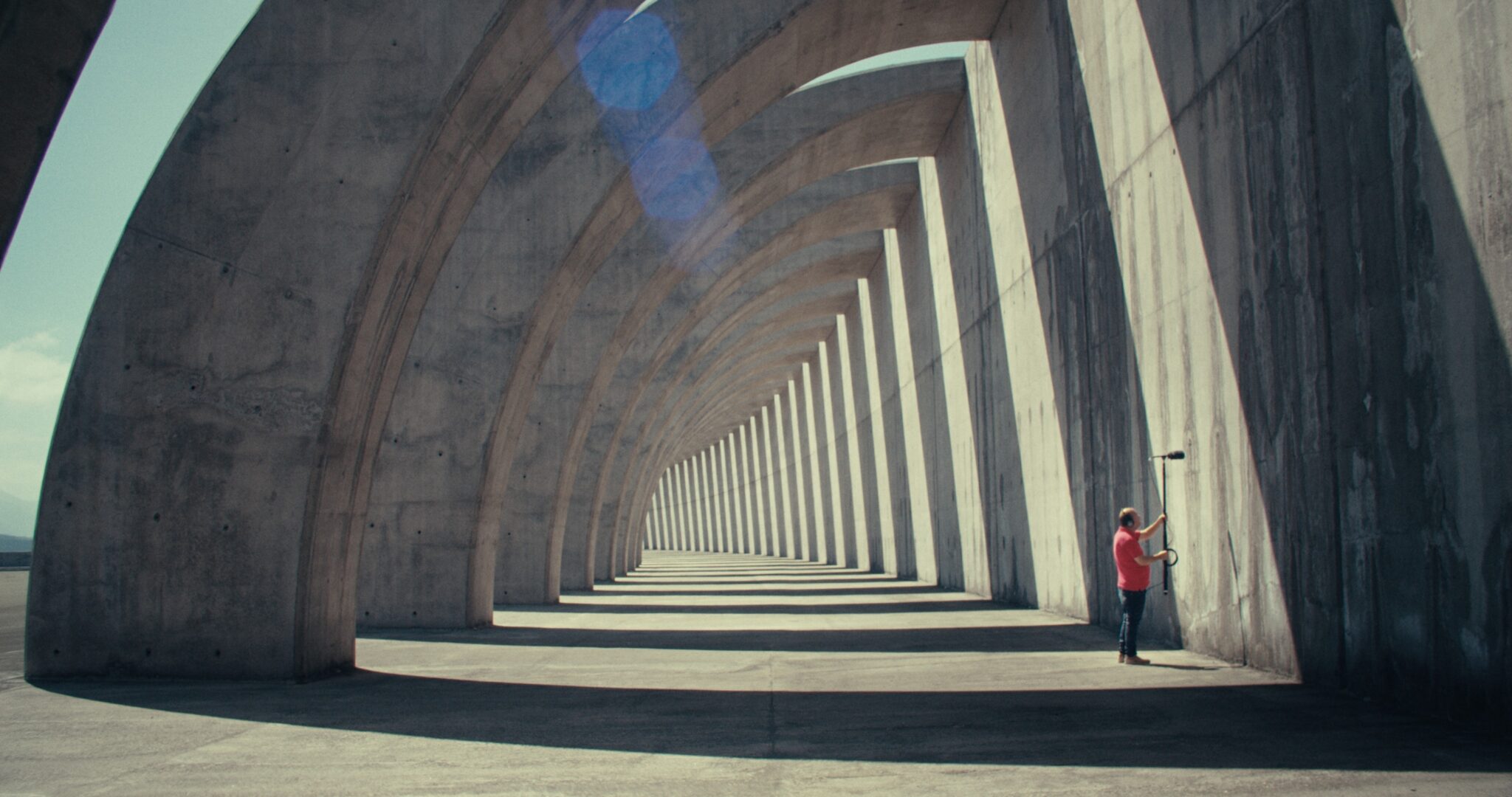
“The intangible, everyday things about life are often the most beautiful, and you don’t realize how beautiful until they’re lost,” he says. “You only know you were in Eden by being banished from it.” Ramón’s ghost-hunting became a way to honour that truth. A man searching the ashes for the faintest trace of memory.
Herzog’s presence on the island shaped the film in ways Kermani never expected. The legendary director insisted that the participants avoid traditional reportage. “We are not journalists,” Herzog reminded them. “You go out there and invent and find the deeper truth.” Kermani took that to heart. He had worried about portraying a tragedy too directly; worried he might misstep, or offend, or simplify grief into something digestible. But Herzog’s challenge liberated him.
“I remember him saying, ‘The facts do not necessarily coincide with the truth,’ Kermani says. “A phone book is factually correct, but none of it tells you why anyone would cry in their pillow at night. It takes poetry to unveil that deeper layer.”
And so Kermani allowed himself to blur the line, to dance between myth and reality. The film feels documentary, but it floats like a fable. It invites the audience to question what they’re seeing while nudging them toward something emotionally honest. He smiles when he admits: “I hope the audience can let go of the need for everything to be black-and-white.” The ghost motif arrived not through gimmick but through inevitability. Everyone Kermani met on the island seemed haunted not necessarily by the dead, but by the absence of what once lived there.
“Even if someone hadn’t lost a loved one, they were haunted by the absence of their previous life,” he explains. Ramón’s obsession became a metaphor for a community living in a new reality where every empty space has a memory attached to it. But ghosts also offered a narrative elegance. Rather than beginning with a tragedy, the film lets us fall in love with Ramón first, his sweetness, his quirks, his sense of wonder. Only then do we understand what he’s searching for. “I’ve always loved the advice of giving the audience 2 + 2 instead of 4,” Kermani says. “Let them piece it together.”
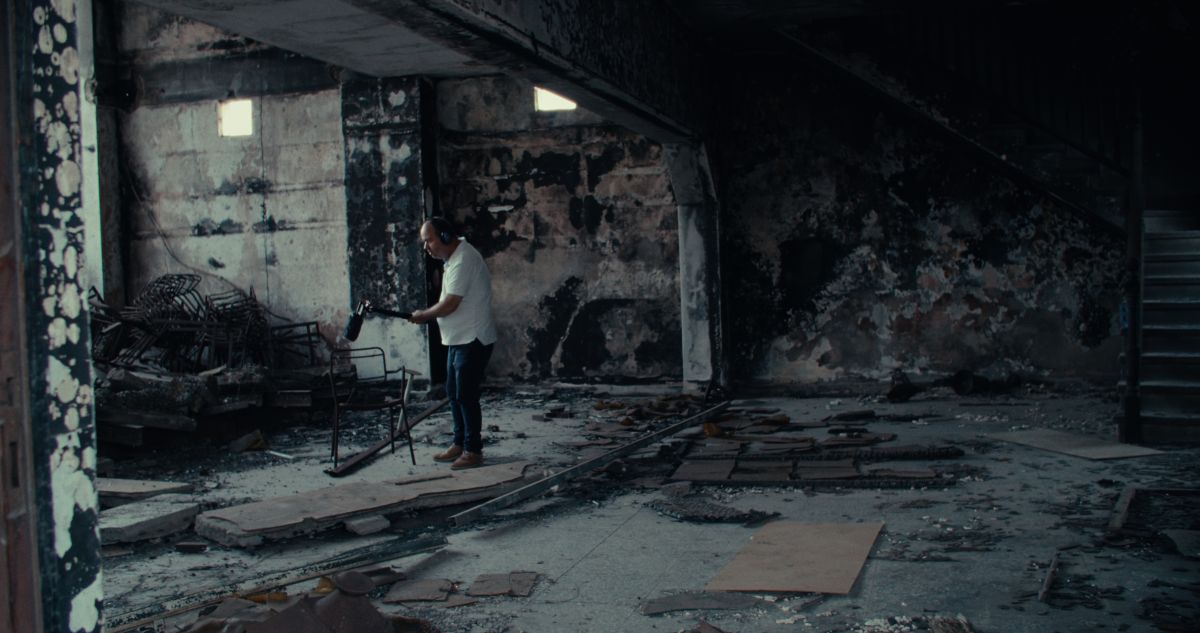
Pedro Moisés Herrera Concepción, who plays Ramón, brought a soulful warmth that anchors the film. “There was something in his eye I thought was so beautiful, the magic of the film really is coming from him.”
If the film is about loss, it is sound, not image, that carries the emotion. Kermani is acutely aware of sound’s power to unveil memory. The contrast between what we hear and what we see becomes the film’s secret engine. One scene features the lively audio of a family dinner, laughter, plates, and clatter over the image of a house swallowed by lava. The effect is devastating. “You get more access to your audience’s emotions via sound than image,” he says. “Sound is a secret weapon.”
This approach was sharpened by necessity. Kermani did not speak Spanish when he arrived in La Palma, relying on his cinematographer, Karla Reyes, to translate while he absorbed everything else like an antenna tuned to humanity. “The stakes were so high,” he laughs. “I learned more Spanish in those ten days than I ever expected.” Kermani didn’t arrive on the island with a plan to define a new voice. Yet, in retrospect, the film feels like a merger of everything he’d been trying to make sense of creatively. His previous project was a pure comedy; his earlier work leaned toward lyrical tragedy. Here, for the first time, they coexisted, humour and sorrow, whimsy and ruin. “This film is the first to really combine those strands in my work,” he says. “Comedy, tragedy, and hopefully poetry.”
In doing so, he found a clarity of purpose: to make films that reveal the extraordinary beating just beneath the ordinary. Films that listen, that pay attention, that take the back door into the heart of what’s real. What lingers most from Ramón Who Speaks to Ghosts is not the supernatural, but the deeply human. The film argues that life’s value is measured in glances, simple moments, routines, and sounds, these unnoticed rhythms that hold entire worlds. Kermani captures this with tenderness and restraint, offering a quiet reminder that the mundane is not merely background noise. It is the heartbeat of existence.